

Einblicke
Artikel und Nachrichten
Boyden Brief Q3 2025: Leaving a legacy – Interims share their insights into the end of an assignment best practice
Market Overview
As the interim market enters the final quarter of 2025, a recurring theme has emerged in client conversations and interim feedback: how to ensure assignments end as strongly as they begin? There is an awareness that interim leaders are brought in to solve urgent problems and to deliver rapid outcomes, but they should also leave behind a sustainable legacy.
From urgent transformation programmes to cultural shifts within established organisations, clients are recognising that the “handover” phase can define whether an assignment delivers long-term value. As part of this quarter’s ‘Boyden Brief’, we asked interim executives to reflect on how assignments should conclude to deliver lasting value. Their responses highlight the balance between immediate outcomes and sustainable impact along with the crucial role of transition planning in ensuring continuity.
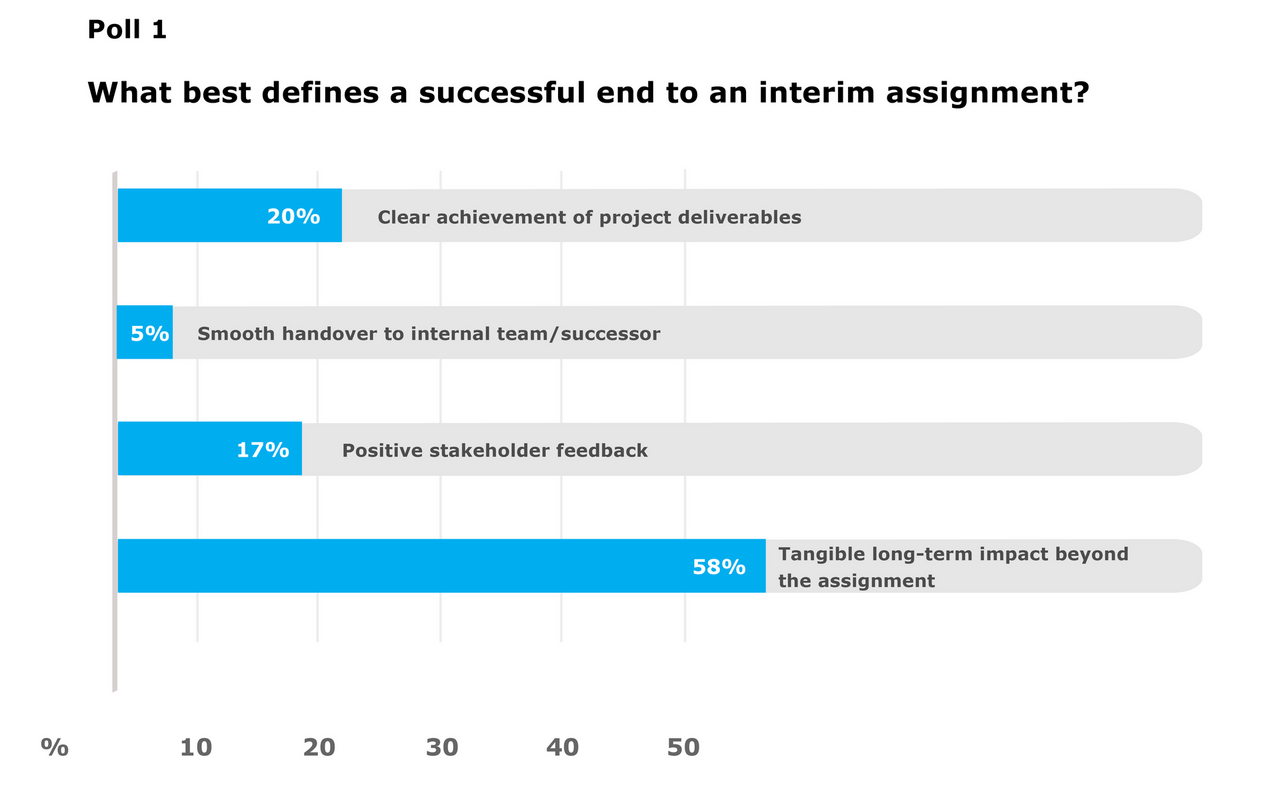
The clear majority (58%) of respondents identified tangible long-term impact beyond the assignment as the defining factor in a successful conclusion. By comparison only 20% pointed to achievement of project deliverables, while positive stakeholder feedback (17%) and smooth handover (5%) trailed further behind. The results suggest that clients and interims alike are invested in long term outputs. While deliverables and feedback matter, it is the ability to leave behind lasting improvements that is viewed as the true benchmark of success.
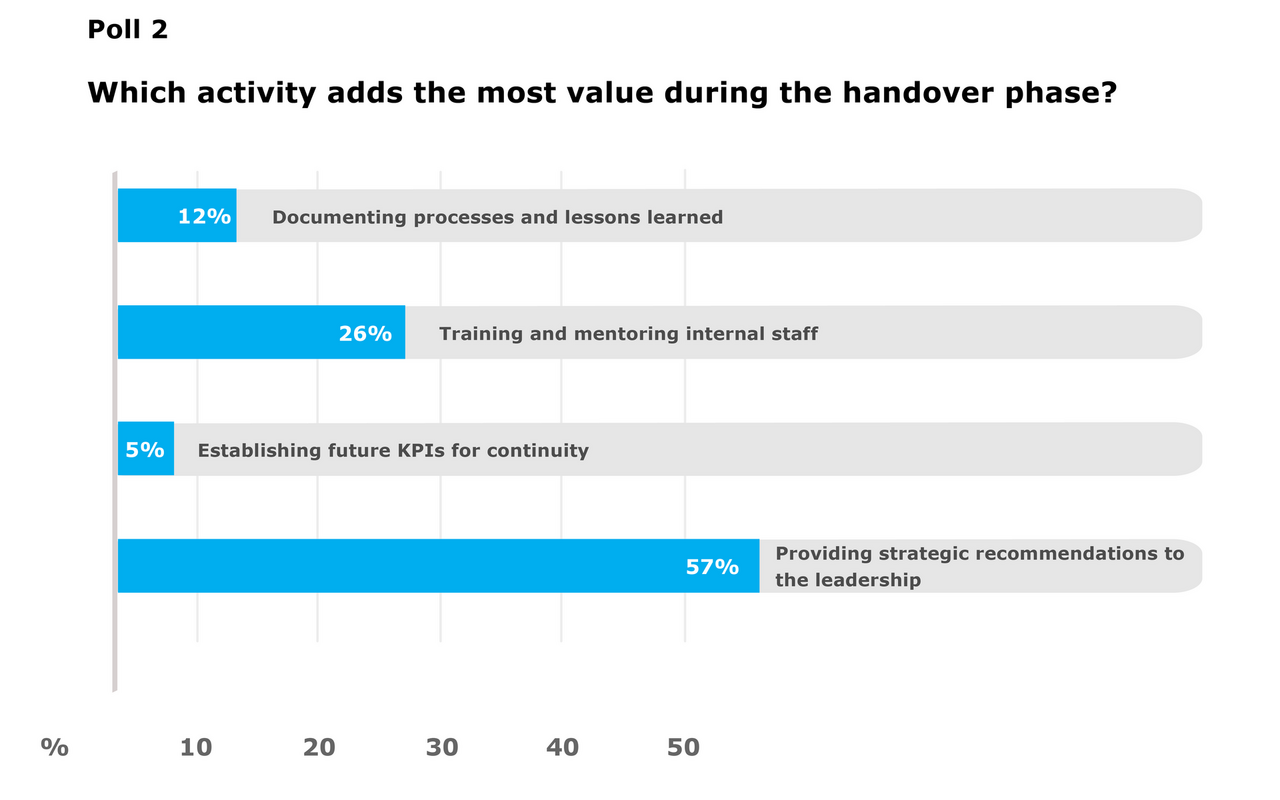
When asked about the most value-adding activity during handover, the majority of interims (57%) selected providing strategic recommendations to leadership. Training and mentoring staff was also cited as being key at 26%, followed by documenting lessons learned (12%) and establishing KPIs (5%). These findings highlight that while knowledge transfer and training are important, clients place the greatest weight on insights that inform future direction. Interims are seen not just as executors of projects, but as advisors whose strategic perspective can shape continuity and longer-term outcomes.
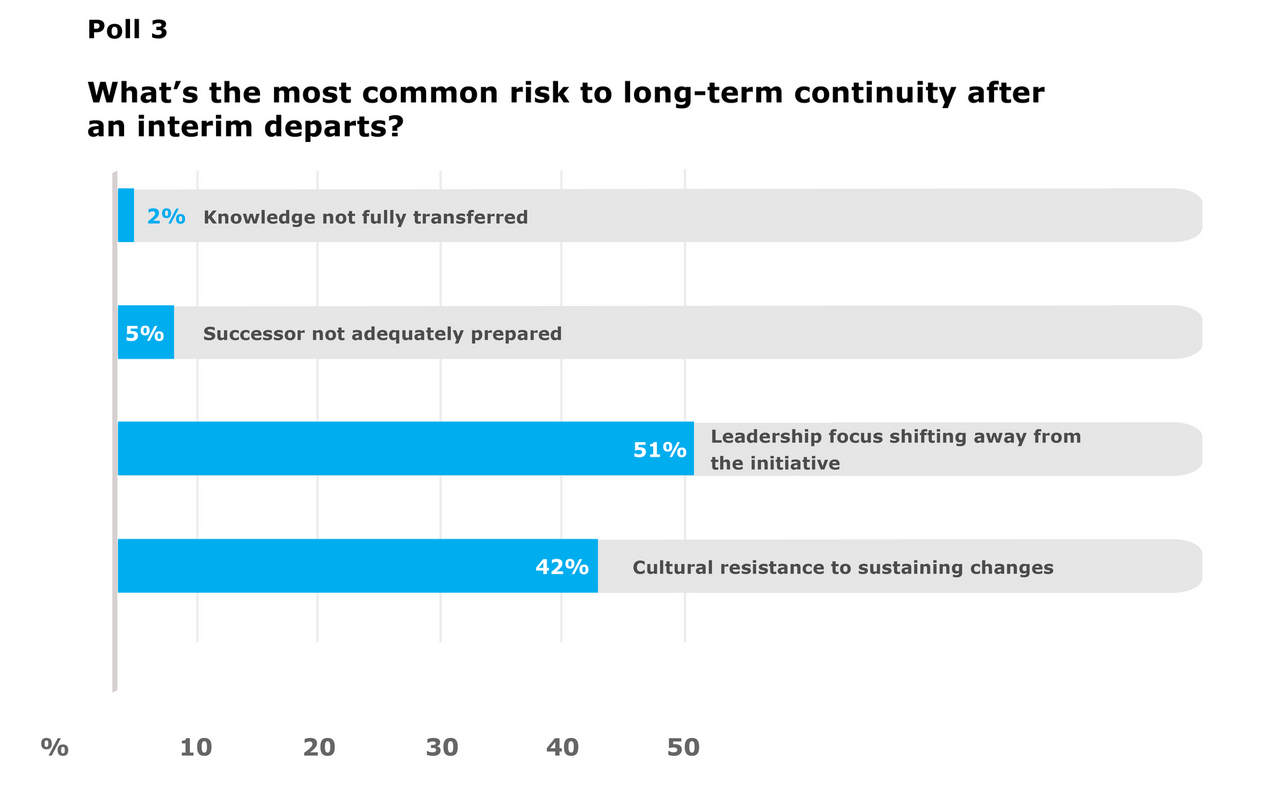
Two risks dominated the results of this poll question: leadership focus shifting away from the initiative (51%) and cultural resistance to sustaining changes (42%). By contrast, few respondents saw successor readiness (5%) or knowledge transfer (2%) as significant threats. This suggests that continuity is rarely impacted by technical gaps alone; rather, they stem from leadership distraction and organisational reluctance to embed change. The data reinforces the point made by many interims: sustaining progress depends less on handover mechanics and more on maintaining leadership commitment and cultural buy-in.
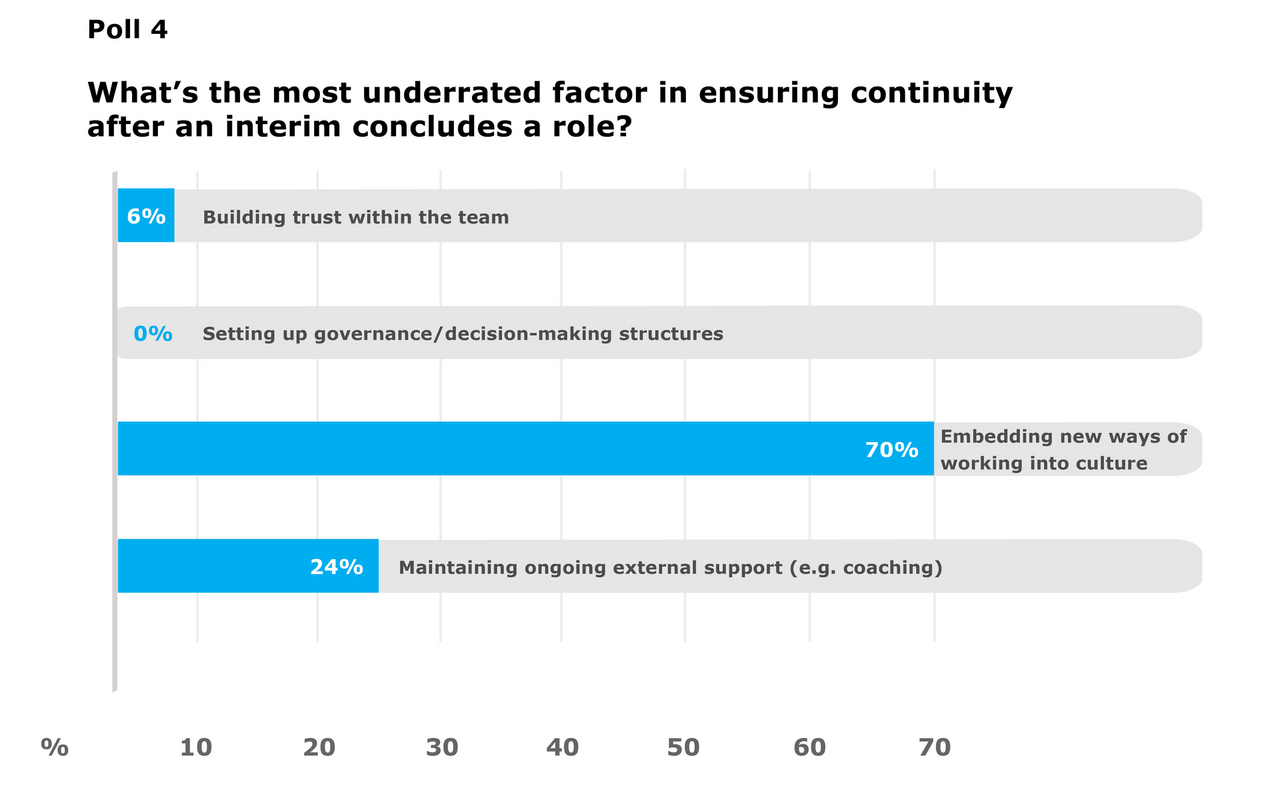
An overwhelming 70% of respondents identified embedding new ways of working into culture as the most underrated factor in achieving continuity. Maintaining external support (24%) was the next most cited, while building trust (6%) ranked far lower. These responses underline that the success of an interim does not rest solely on processes or formal structures, but on whether cultural behaviors and practices become part of the organisation’s DNA. Without that adoption, even well-designed initiatives risk losing momentum once the interim departs.
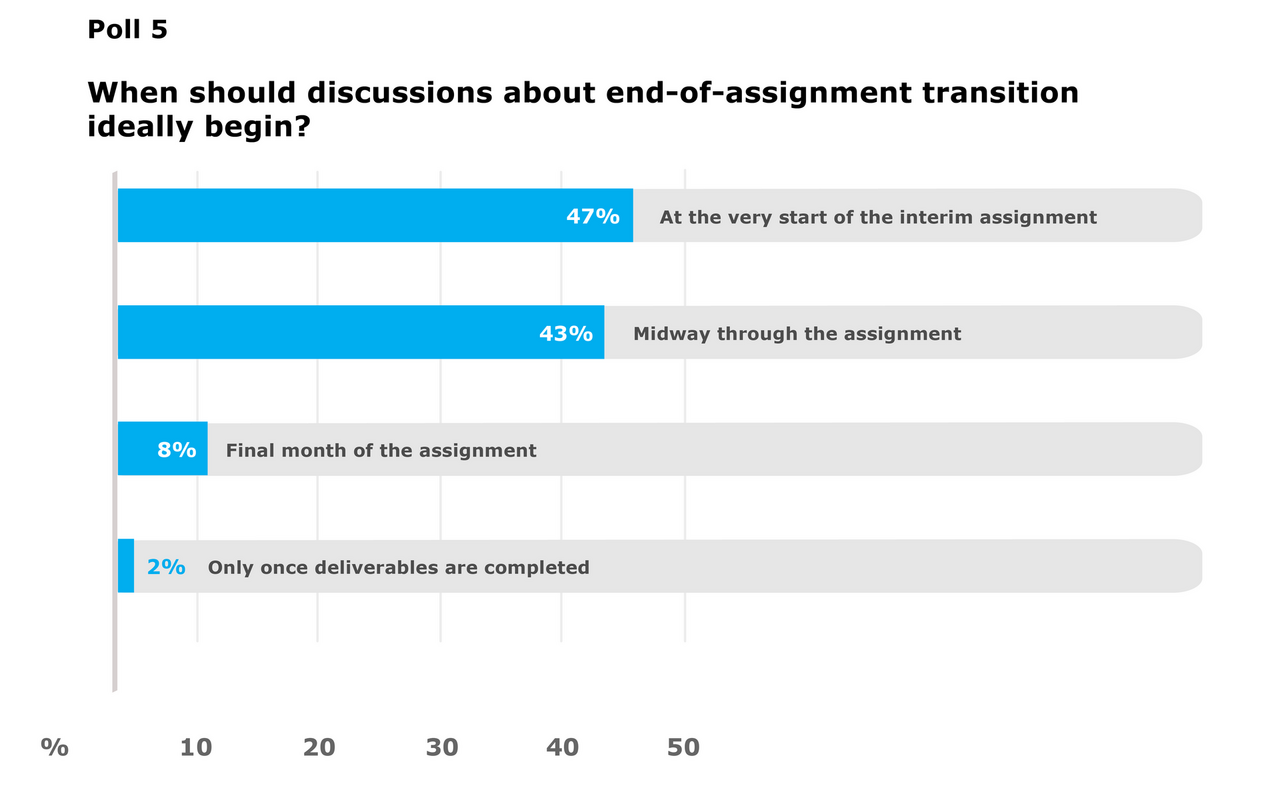
Close to half of respondents (47%) believe that transition planning should begin from day one, with a further 43% advocating that it start midway through the assignment. Very few felt that leaving it until the final month (8%) or post-deliverables (2%) was sufficient. The near-unanimous emphasis on early planning suggests that legacy is not an afterthought: it must be built into the interim management assignment from the outset. For both clients and interims, this means defining what success looks like at exit and revisiting it throughout the assignment to ensure momentum carries beyond the interim’s tenure.
Insights from Interim Leaders
Interim executives reflected candidly on what it takes to finish an assignment positively:
- “Not one brief stays the same – constant dialogue with clients is essential. By the final phase, expectations may look very different from the start.”
- “I often step back a month before leaving to see if what we’ve built can stand on its own legs. It’s the best way to find and close gaps before exit.”
- “Culture is usually the deciding factor. The most successful outcomes happen when clients acknowledge and address cultural issues, not just technical fixes”
- “Quick wins build trust, but it’s the long-term objectives that define legacy. Both must be kept in focus.”
- “Handover is not just about documents – it’s about relationships, coaching, and embedding capability.”
Several interims also noted that post-assignment consultation or short-term coaching can add value, provided boundaries are clear and credibility is maintained.
Conclusion
Managing an assignment to a positive conclusion depends on foresight, cultural alignment and leadership commitment. As our survey and conversations with our interim community show, legacy is defined not by deliverables alone, but by what endures after the interim has gone.
At Boyden, we are privileged to work with exceptional interim leaders and clients who are navigating these challenges in real time. By sharing their experiences and perspectives, our aim is to share our insights to ensure clients can maximise interim leadership. We hope to spark discussions and help organisations to think differently about utilizing interim leadership effectively.
As we head into Q4 and beyond, the challenge for organisations is clear: ensure that interim leadership delivers not only results today, but resilience and continuity for tomorrow.