Tactics to get the best from the CEO
Of course, CEOs need to be fully in control of detail and are usually highly capable in this, managing their time to absorb detail when they have the most energy. At other times, there are practical actions executives can take to support the typical CEO in mitigating differences in preference:
- Stipulate how you want meetings to be run. Meetings need to be structured to allow time to go into detail with discipline and focus, and also to engage in more inspiring, creative discussions. Be explicit about which type of discussion you are having, to enable the CEO to increase their focus on detail when required.
- Be prepared to adapt your style to theirs. It helps for others to be aware of and accommodate the CEO’s natural tendencies. This minimises the risk of the CEO appearing disinterested or careless, which can be detrimental to relationships, reputation or outcomes.
- Support those on whom the CEO depends for detail. Often executives are given specific roles to support the CEO in covering minutiae and discipline. These individuals need to be acknowledged as crucial to complementing the CEO, particularly by the leadership team, and fully supported with their capabilities harnessed, rather than being side-lined.
- Leverage others with different preferences in the leadership team. Ensure that an individual with a different work style to the typical CEO – this may be the CFO or General Counsel – is given a role that contributes in a broader or more informal sense to the team. This will leverage their natural preferences, which are typically different from those of a CEO.
This doesn’t reflect me / or the CEO I work with
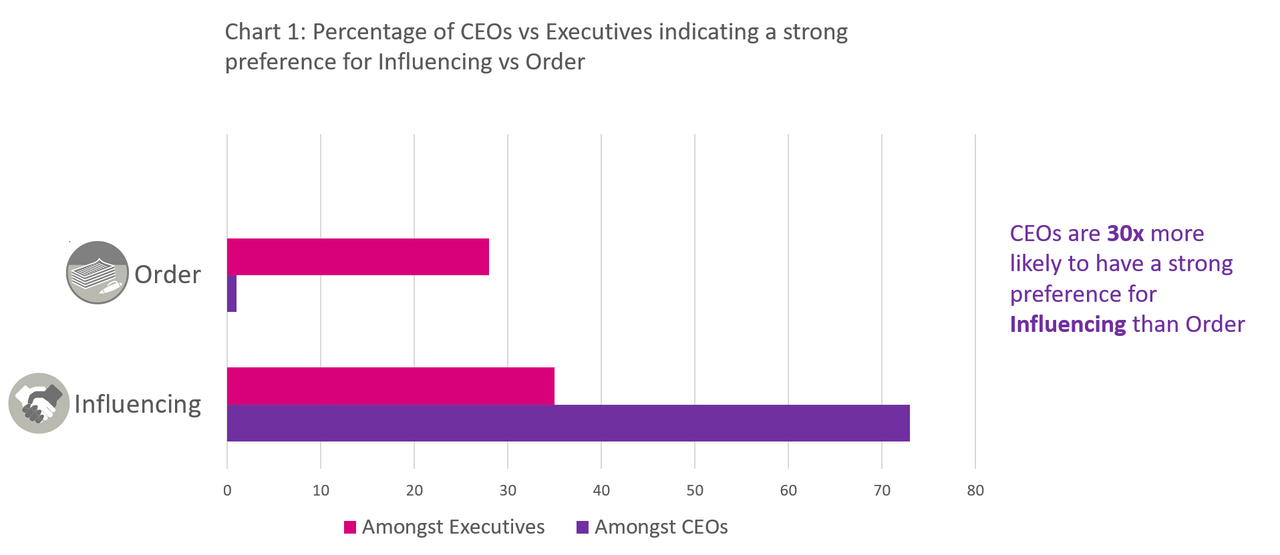
Not all CEOs conform to this profile; for example, 5% of CEOs have a low preference for Influencing. In this situation, a CEO may need to be encouraged to share their vision and more deliberately motivate direct reports and their teams. Whilst this low preference for Influencing is not the ‘norm,’ these individuals may be no less successful in their role and outcomes; they will, however, approach the role with a very different style.
Questions to consider
- Are you appointing, or currently being led by, a typical or an atypical CEO?
- How is the CEO perceived in the organisation?
- Low preference doesn't mean low ability; how can the CEO address their preferences and harness others around them?
- Who will complement the CEO and how?
About Boyden and Building High Performing Teams
Boyden is a premier leadership and talent advisory firm, with more than 75 offices in 45 countries. With over 150 certified practitioners, Boyden uses PROPHET in leadership consulting engagements and also in executive search; fast-tracking the assignment, enhancing the relationship between client and candidate and supporting the successful integration of the appointed executive into their new team.
PROPHET is not used to inform a selection decision, as it is not predictive of performance. It does, however, provide valuable insight on how an individual will approach their role and the style of their decision-making. With PROPHET, the appointed executive and key stakeholders will have an initial understanding each other’s work preferences, establishing a high-performing business relationship from the outset.