The biotech industry, predominately pre-commercial publicly listed companies, is some way behind the curve, with a recent study conducted by law firm Fenwick reporting a huge 70% who have not referenced ESG in their recent public disclosures. Factors such as the maturity of a company are key considerations, as the longer a company is public, the more likely it is to report on such practices. With 2021 seeing a record-breaking number of initial public offerings (IPOs) by biotechs, we are likely to see a flurry of ESG disclosures over the course of 2022 and beyond as the U.S Securities and Exchange Commission (SEC) tightens the screws on reporting requirements. This is further backed up by the Fenwick survey which reported that out of 100 biotech executives approached from biotechs and investors with a market cap of $100 million to more than $4 billion, ‘92% of respondents think ESG disclosures will become more important in 2022’. Specific to investors, it was reported that they ‘expect ESG’s prominence to grow’ and ‘pointed to increasing pressure from clients to include ESG-focused companies in portfolios’.
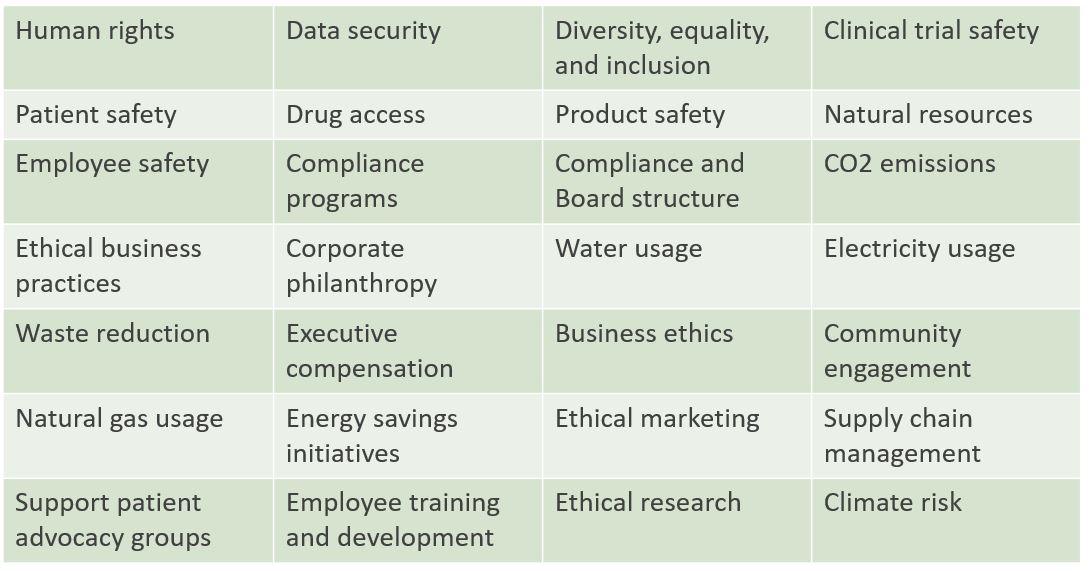
Before we discuss why ESG factors are likely to be the cornerstone of future investment decisions, it would be sensible to look at the metrics that are likely to be reported. It is widely reported that investors and executives think there is a clear lack of standardised reporting metrics, so if mandated by the SEC, efforts must be made to ensure the reporting metrics are transparent. In turn, this will give investors and executives the ability to measure year-on-year progress and allow for cross-company comparisons, likely facilitating further ESG reporting. Josh Blackman, Partner in Boyden’s UK & Ireland Healthcare & Life Sciences practice strongly believes that the industry clearly sees the importance of the ESG agenda but high levels of ambiguity around what is required to be reported on are stifling progress
.