In this edition of Navigating Uncertainty, explore how global instability is reshaping private equity as firms adapt through diversification, defensive strategies, and AI-driven value creation to turn uncertainty into opportunity.
Private equity and venture capital are being tested in new ways as markets shift, policies evolve, and global dynamics realign. In this environment, leaders are under pressure to act decisively while navigating constant change.
Boyden’s Private Equity & Venture Capital Practice brings clarity to this complexity, examining how uncertainty is influencing investment strategies, portfolio performance, and leadership priorities across the sector.
Each edition of the Navigating Uncertainty series explores a defining trend shaping the future of private equity and venture capital. Through the perspective of Boyden experts worldwide, the series delivers forward-looking analysis, actionable insights, and leadership intelligence to help investors and portfolio executives anticipate what’s next and lead with confidence.
Expert commentators suggest we have reached ‘peak private equity’. Is this true? Has private equity outgrown it’s own market, submerged by complexity, uncertainty and fraying confidence?
No. Private equity is responding to geopolitical uncertainty and volatility with opportunistic, defensive and other distinctive approaches.
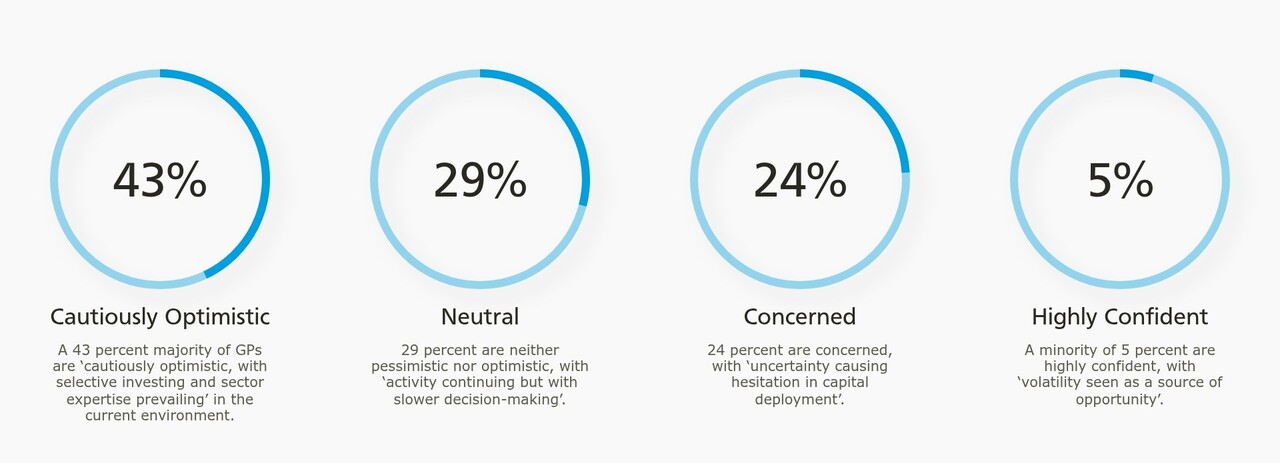
Boyden poll data show:
Source: In October 2025 Boyden conducted a poll among the firm’s global private equity & venture capital experts, capturing sentiment and strategies among clients, GPs, LPs and commentators in the sector.
Opportunity: global recalibration, idiosyncratic deals, power shifting East
Politico-economic change in the United States, Europe, Asia and the Middle East is driving a shift in portfolio construction, with GPs recalibrating global strategies, notably geographic diversification. We see them leaning into more idiosyncratic opportunities, and addressing demographic changes: baby boomer retirement impacting the economy and social security in the US; aging populations straining social security and healthcare in Europe; and growth of the middle class in Asia shifting global economic power to the East. In the Middle East, family businesses are partnering with private equity to fund growth, ESG-focused investment is gaining traction, as well as co-investment between sovereign wealth funds and GPs.
Emerging opportunities abound to provide capital and leadership to support socio-economic change driven by government policy, primarily centred around digitising the economy through advanced AI and quantum technologies, infrastructure and renewable energy.
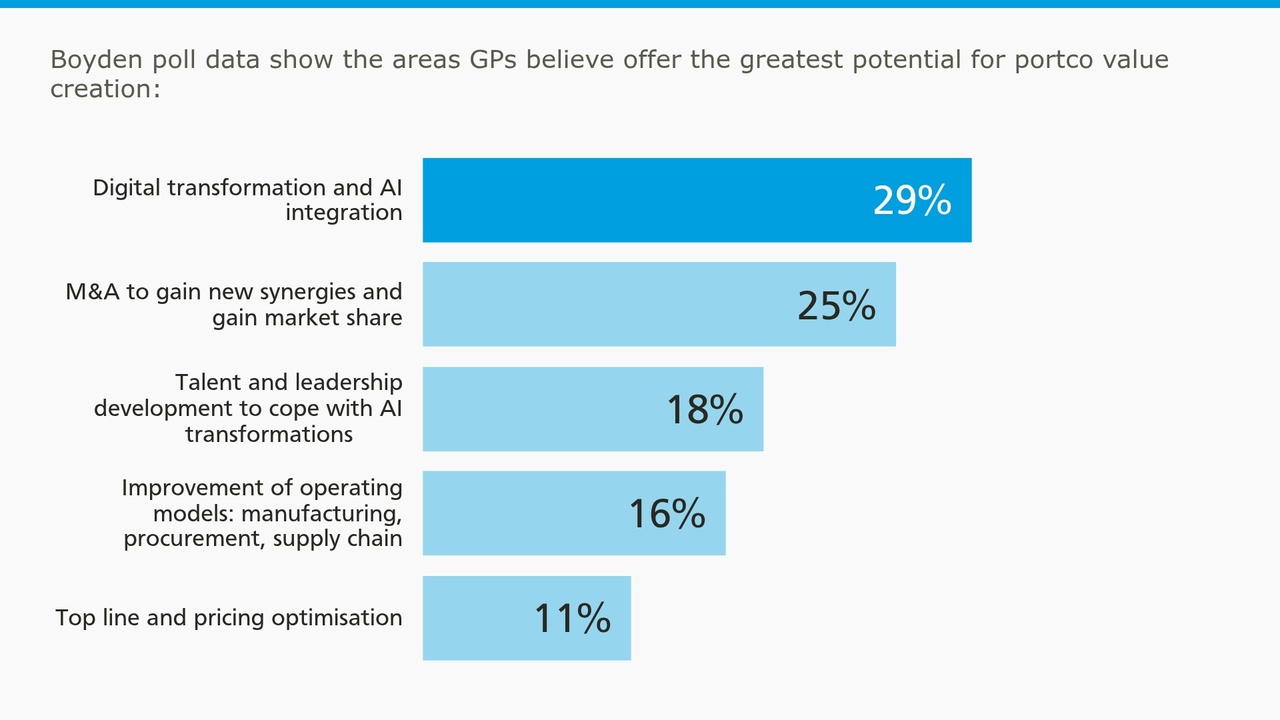
Boyden poll data corroborates this: ‘sectoral concentration in resilient areas (AI, healthcare, energy, infrastructure)’ is the top strategic adjustment most commonly made among GPs navigating an unstable environment.
“These changes require leaders with specific technical, collaborative and influential skills to harness new dynamics in transforming industries,” comments Kathy Patillo, Managing Partner, United States, and Global Leader, Financial Officers Practice, at Boyden. “Unique opportunities demand unique talent, and we are identifying exceptional talent pools globally for private equity firms and portfolio companies.”
Through ‘investor governance'1 and active ownership models, private equity is enlivening today’s most notable opportunities in terms of both capital and talent.
Defensive moves: semi-liquid structures, evergreen and continuation funds
With GPs maintaining investments over longer time periods, defensive moves include addressing liquidity through the secondary market, semi-liquid structures, evergreen funds and GP-led secondaries such as continuation funds. Valerie Baudson, CEO of Amundi comments, “[Given] performance, transparency, liquidity, vision... secondaries is, for me, one of the most interesting asset classes, or expertise, in the private asset area today”.
Boyden poll data reveal: ‘continuation and evergreen funds’ are the second most common strategic adjustment to market conditions among private equity firms.
Other approaches: targeting private wealth, and co-investment strategies
In a major shift, GPs are leveraging semi-liquid or evergreen funds to broaden beyond institutional LPs and attract retail investors keen to diversify, particularly given stock market volatility and private equity’s comparatively higher returns.
In addition, LPs seeking a more proactive role in the pace and scale of investment are attracted by co-investment and direct deals. For GPs, co-investments solve longer fundraising cycles, with a record $33.2 billion in global capital raised in 20242. Bigger deals may also spur GPs to offer co-investments to all their LPs; 2025 is on track to be the strongest year for large deals by volume since 2021, making it potentially the second strongest year in history for large deals3.
Uncertainty: more opportunity if you can spot it, better results if you have the talent
Today’s environment plays to private equity’s strengths. The most successful GPs are highly skilled at spotting opportunity in an uncertain, complex and evolving climate, planning and working to the longer term.
In the current market, size matters, reducing perceived risk. While annual increases in fundraising slowed in 20244, very large GPs had fewer problems raising capital, with the biggest attracting the greatest share of funds raised: the top three (KKR,EQT and Blackstone) each raised almost $100 billion and above, while the top 10 each attracted nearly $50 billion and above5.
Lionel Assant, Co-Chief Investment Officer, Blackstone says, “Moments of distress or uncertainty present more opportunities than challenges”. Just like wealth managers, PE experts have to ignore the “noise of volatility” and leverage their natural advantage of long-term investing without the pressure of quarterly reporting.
According to IPEM’s Daily Spin6, deals completed during high policy uncertainty have historically delivered better results, up to a 10 percent difference in annual alpha, compared with deals in periods of less uncertainty. Performance data show that GPs able to arbitrage economic policy uncertainty pursue sharper strategies, new investor bases and innovative financing models. They also benefit from fewer competitors, lower valuations and a long-term focus in periods of uncertainty.

At IPEM 2025, there was a consensus among LPs therefore that despite lower returns, high valuations, increased competition and financing challenges, we are not at ‘peak private equity’. The notion of an ‘optimal size’ is premature, particularly with public ownership eclipsed by the attraction and growth of private enterprise.
The number of public companies peaked in 1997 before a steady decline, with 2.5 times more private equity-backed than publicly-traded companies in the US at end of 2023. As the public market contracts, PE-backed companies attract greater investor interest. However, while attracted by value creation, they must address talent risk: GPs and portco leadership still need the discipline of public market scrutiny.
“Value creation is an absolute must in itself and in terms of leadership capabilities,” asserts Anita Pouplard, Managing Partner, France and Global Leader, Private Equity and Venture Capital Practice, at Boyden. “A fund’s approach to value creation is now its top differentiator, and for that the focus is firmly on AI. Private equity firms are chasing AI transformation experts for their own teams to help drive value creation at scale among portfolio companies. From everything we see at Boyden, AI talent will power the future of private equity”.
A new, recalibrating world: mid-market strength in the US, scalability in Europe, greater penetration in Southeast Asia
Despite market headwinds and turbulence, Valerie Baudson, CEO of Amundi is optimistic, insisting that markets adjust to new realities. From a global perspective, Baudson outlines, “The exceptional performance of the US has faded, and European markets will continue to attract growing interest from international investors”.
We are perhaps seeing a levelling off in the US, while opportunities, and scalability in particular, abound in lagging European markets. Nonetheless, the US offers buoyant opportunity in tech, software and AI, healthcare, manufacturing, infrastructure, private credit and mid-market companies yielding returns through expansion and operational improvements.
In Asia, private equity penetration is low, particularly in high-growth Southeast Asia; here, digital transformation and AI implementation are driving investment, as well as biopharma, medtech and healthcare IT.
Europe takes centre stage
While 53 percent of international LPs report backing funds investing in the US, 83 percent plan allocation to funds investing in Europe; the absolute number of funds planning to invest in Europe is up by more than 80 percent on 20247.
Europe needs as much as €800 billion in capital a year, according to Mario Draghi in his report on European Competitiveness. Large players are leaning in; KKR invested $10 billion in private equity in 2025. The Continent is addressing “under-investment... in digital infrastructure, in energy and in defence,” commented Philipp Freise, co-head of European Private Equity KKR, adding, “The size of the opportunity is scaling very fast... eighty percent needs to come from the private segment”.
The fragmentation of EU capital markets is also attracting more private capital, boosting GP confidence and driving investment, including Blackstone’s $500 billion in Europe over the next 10 years, on top of $350 billion invested in 2000 to 2025. Contrast this with planned investment in Asia (primarily India and Japan) of $10 billion, and a nine-point drop in commitments in the US, with 67 percent of LPs planning investment for 2026, compared with 76 percent in 2025.
In Europe, greater knowledge of private equity and private debt has spurred significant interest in both capital and talent. In turn, GPs are targeting strong management teams to navigate a patchwork of volatile European markets.
Tech – notably AI – leads resilience through economic cycles
In the face of volatility, Alix Partners notes tech & software, healthcare, industrials & materials and business services offer resilience across economic cycles, with GP skills well matched to LP interest: nearly 17 percent of LPs are looking to invest in tech & software. Analysis reveals AI as the top subsector, attracting 15.5 percent of LP investment, followed by 12.5 percent in cybersecurity and 12.2 percent in green and climate tech.
Global instability reshapes private equity: private equity, in turn, reshapes the global landscape
Private equity is adapting to the changing environment both as an industry and through investment strategy. It is evolving into a mainstream part of the commercial world as political and business leaders look to private equity for much needed investment. As participation in M&A continues to grow, driving successful consolidation and industry transformation, the sector increases its overall impact on the financial, economic and philanthropic landscape.
We will continue to see the increasingly positive impact of private equity, shifting from a little understood, ‘behind closed doors’ form of expertise to a catalyst for innovation and modernisation. It promises to reinvigorate flagging economies and potentially improve lives, through digital, infrastructure, energy and defence strategies. Going even further, as Lionel Assant asserts, referring to the Private Equity Foundation renamed Impetus, “It’s a ‘must do’ to give back for all of us in the industry”.
For PE/VC firms seeking to discuss their leadership strategy, Boyden's Private Equity and Venture Capital Practice offers the global expertise and local insights necessary to identify, evaluate, and place the executives who will drive success in your business.
Articles
World Economic Forum Bridging the divide: Private markets and new drivers of value creation
S&P Global Global private equity deal value 2025
S&P Global Outsize deal drives Middle Eastern sovereign wealth fund co-investment surge
Charles Russell Speechlys From Tradition to Transaction – the rise of private equity in family businesses in the Middle East
PwC AI and private equity fuel surge in large M&A deals
EY Private Equity Pulse Q2 2025
FTI Consulting AI Radar for Private Equity
World Economic Forum How tech innovations are transforming private equity
IPEM Allocation and Fundraising Trend Report 2026
Video
Blackstone’s Lionel Assant at IPEM 2025
Amundi’s Valerie Baudson at IPEM 2025
KKR’s Philipp Freise at IPEM 2025
Podcasts
How can private equity strengthen itself to continue its growth?
What will private equity look like in 2050?
[1] A phrase coined by the World Economic Forum
[2] Source: chronograph.pe
[3] PwC: at 5th September 2025, there were 144 large deals worth $1 billion - $5 billion, and 47 megadeals, over $5 billion, according to PwC’s analysis of S&P Global Market Intelligence. Market volatility driven by shifts in trade policies shows no impact on continuing confidence in large deal making, with anticipated exponential growth in megadeals compared with 2024 (up 31 percent).
[4] Private Equity International’s 300 index 2024 (PEI 300) shows an uptick of 0.37% yoy, versus an average 11 percent increase since the index began.
[5] Source: PEI ibid
[6] Daily Spin, 24th September 2025
[7] IPEM Allocation and Fundraising Trend Report 2026, Alix Partners