Articles & Papers
Leading Transformation Report 2021
The pandemic accelerated change processes whose effects we are feeling to this day. Our latest report shows how leaders can approach the complex challenges of 2021, and which leadership patterns are standing out.
By Boyden, Futureworks, Information Factory, and Küng Strategy Consulting
"We are constantly in a state of transformation. It is a continuous process."
"We have to question everything."
The COVID-19 pandemic has brought transformation to all of us. The lockdowns that began in March 2020 left virtually no business untouched, as companies throughout the economy had to adjust to a whole new reality. Transformation is no longer something extraordinary. It has become an accepted process, through which companies are constantly optimising and readjusting to a volatile and complex environment.
It falls to leaders to plot a path forward. Our research shows that they are changing not only dimensions of their businesses, but also the way they lead.
Nothing Stays the Same
88% of participants responded with yes when asked whether their business was planning or undergoing a transformation process, or had recently completed one. We find it particularly interesting that the remaining 12% who responded, emphasised that they see transformation as a permanent process, rather than a project that can be completed.
Big Companies Have Most to Achieve
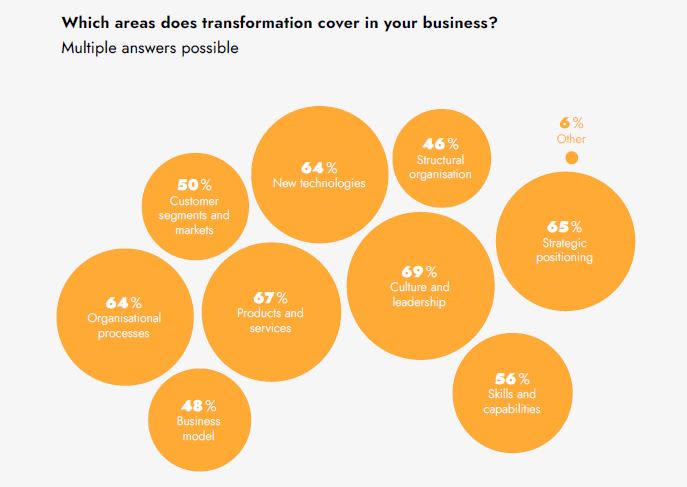
When we compare the answers according to company size, the differences in terms of business model, customer segments and markets, products and services, and skills and capabilities are relatively small. This means that small and large companies alike are equally prepared to make changes in these areas.
When it comes to strategic positioning and culture and leadership, however, it is a completely different picture. Large companies are much more active in these areas than their smaller counterparts. This suggests that although companies of all sizes recognise the need for change here, making this change happen seems more complex for large businesses.
Transformation Means Proactively Engaging with the Future
When asked about the level of progress in the transformation process, respondents indicated that they were least satisfied in the areas of process organisation and culture and leadership. This correlates with the need for action that respondents see in these areas. Dissatisfaction with the status quo is a clear driver of transformation projects.
But it is not the only one. For the factors customer segments and markets, products and services, and strategic positioning, leaders also see a need for action even though they are satisfied or very satisfied with the status quo.
This shows that transformation processes are also motivated by the desire to proactively initiate positive developments. From here, one transformation inspires another. Optimising process organisation, for example, can also be seen as a way to boost increasingly important employer attractiveness. Effective processes are an important qualitative element that can make a real difference when it comes to gaining or retaining highly qualified staff.
Transformation is not a one-off process, in which companies follow a fixed plan to reach a perfect target state. Instead, it is a constant process of
optimising the interplay of all elements involved, in order to create an attractive future.
Even if there is no master plan for successful transformation in the respective areas, 2021 has shown specific patterns that can effectively steer transformation.
“The most important thing: shared values. They create a stable focus, regardless of temporary trends and
setbacks.”
“When it comes down to it, we know we can rely on each other.”
“Cultural aspects drive innovation.”
Motivation Through Purpose-Driven Principles and Shared Values
The larger a company’s size, the more difficult it is for employees to meaningfully recognise the impact of their individual actions. A purpose-driven principle and shared values are becoming a decisive and intrinsic motivating factor. A good example of this is the street cleaner at Cape Canaveral who, when asked what he was doing by the American president, responded: “We are sending a man to the moon.”
Respondents named a shared value system (20%), qualified and loyal employees (17%) and the business model (11%) as the most important assets on the path to the future. The importance of shared values can also be seen in the fact that culture and leadership was named as the most important area of action in 2021.
“The key ingredient for success is intense collaboration with customers at all levels.”
“We have invested more time in customer relations.”
Regularly Checking In: Where are We and Where are We Going?
Achieving a goal is easy when it is right in front of you. Finding your way in a volatile, uncertain, complex and ambivalent environment is much more difficult. In situations like this, knowing where you are and which direction to go is often more helpful than understanding the end goal. It is a bit like a sailor using a compass. Despite rough seas and the curvature of the earth, it shows the way to a destination that is out of sight.
This is reflected in the importance of strategic positioning on the market as one of the main areas for action in 2021. This, despite the fact that satisfaction is highest here compared to all other areas (see page 11). Companies continue to optimise this dimension due to the way that strategic positioning acts as a kind of compass for everything else.
Summary: Short-Term Survival Mode is Giving Way to Securing Long-Term Success
In 2020, leaders focused almost exclusively on restoring value-creation chains and productivity. In 2021, we can see that transformation has developed from pandemic-driven disruption to everyday business practice. Leaders see transformation as the way to secure success.
The patterns with which companies are successfully steering transformation today have changed accordingly. 2021 is about:
- Shared values
- Regular check-ins
- Quick, measurable results
We would like to say a big thank you to all participants for sharing their thoughts and experiences with us so openly. We would also like to thank the project team who made this report possible.
Leadership in Transformation - Making Sense of it All
By Peter Stücheli-Herlach*
Leadership is about actively shaping the future. It means leading the way and taking a company forward. The required expertise changes just like the coordinate systems used to determine success. This is because customers, employees, technologies, processes and surrounding conditions are constantly changing too.
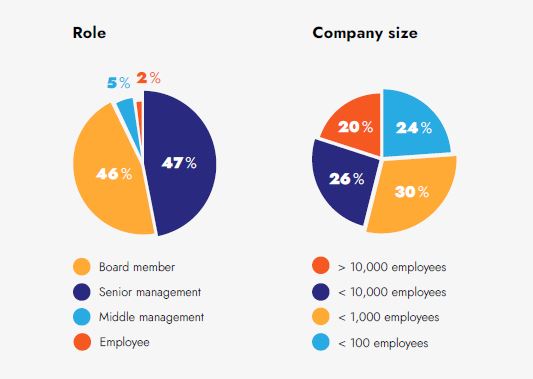
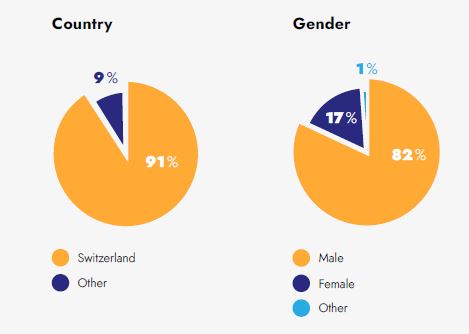
This report serves to shine a light on how this affects the Swiss economy. Over 300 leaders responded to our request to share their experiences. Their answers paint a picture of leadership that calls for a more detailed interpretation.
When we look at managerial practice, we see that it is here where change is taking place. This change reflects the trial-and-error nature of management today.
It has long been impossible to truly analyse today’s business environment without mentioning VUCA. Whether in person or online, the need to restructure hierarchies in digitalised network organisations is the hot topic of every after-work drinks session.
It is this environment in which leadership needs to find its sense of direction. It must show the way to creating value in a VUCA world. The situation illustrated by this report shows how this can be done successfully in everyday business life.
First: good decision-making requires good communication. And second: effective strategy work always interferes in everyday business and cannot be justified through theory alone. This can be seen in the three areas in which leadership must prove itself.
* Professor Peter Stücheli-Herlach is Professor of Organisational Communication at the Zurich University of Applied Sciences (ZHAW). Together with François Cooren, he recently published the Handbook of Management Communication (2021, Mouton de Gruyter, with contributions from 54 writers from 14 countries across 4 continents).
Leadership in Context - A Matter of Relationships
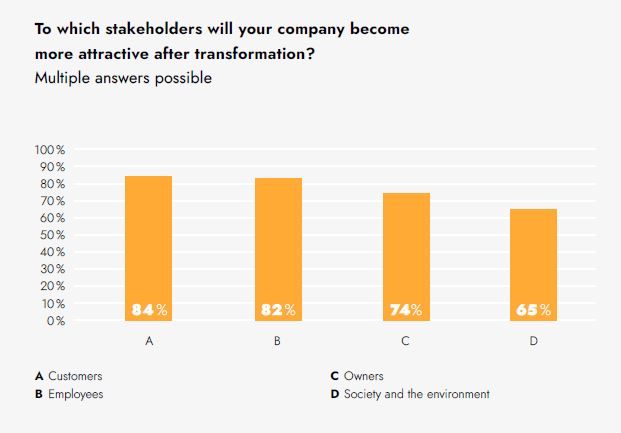
Change is all about taking decisions, but also about changing decisions for the greater good. Bringing about the necessary change is always a matter of sustainable, and therefore changeable, relationships. Leadership means managing relationships and requires collaboration with stakeholders. The responses from the surveyed leaders confirm this. The necessary changes do not just concern processes and technology, but also positioning and corporate culture. Meaningful change is impossible without constant and honest discussion with stakeholders. Without good communication, companies will be unable to even decide to bring about change in the first place.
Leadership in Business - A Matter of Strategic Practice
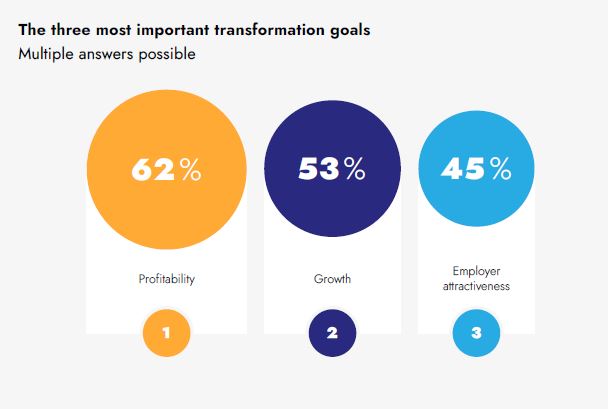
The people who are best placed to show the path to success are those who show what success looks like. Leadership is about proving that what is necessary is also achievable. The answers of our respondents show that it is not just profitability and growth that are worth striving for. They show the equal importance of maintaining attractiveness as an employer. Strategy work is not about promising success, but rather working towards and achieving it together.
Leading People in Markets - Choosing the Next Move
The strategic practice of change is always something real. It is something that can be experienced, communicated and learned. In order to take the next move, one first needs to see it. Leadership is about shaping the corresponding actions. This is how leaders highlight the need for proactivity and emphasise the importance of values that remain solid as situations change. Leadership strikes out through initiatives that can be clearly explained.
This report is yet more confirmation of how effective leadership is a matter of successful communication.
1. Who helps you to regularly question your strategic assumptions?
2. What gives you the conviction and confidence that you are on the right path?
3. Who do you listen to? And why?
4. What effect is digitalisation having on your processes and business model?
5. How do processes influence your attractiveness as an employer?
6. Can you handle complexity or do you try to avoid it?
7. How do you discover the questions that your customers and employees are asking themselves?
8. Are you constantly making sure that your business provides satisfactory answers to these questions?
9. How often do you speak with your customers and employees?
10. Is experience in transformation a must-have for leadership?
11. Which leading indicators best complement your financial metrics?
12. How can you improve the collaboration of key resources through transformation?
Read the full report in English or in German or contact Patrick Naef, Managing Partner Boyden Switzerland or Armin Meier, Managing Partner, Boyden Switzerland for more information.