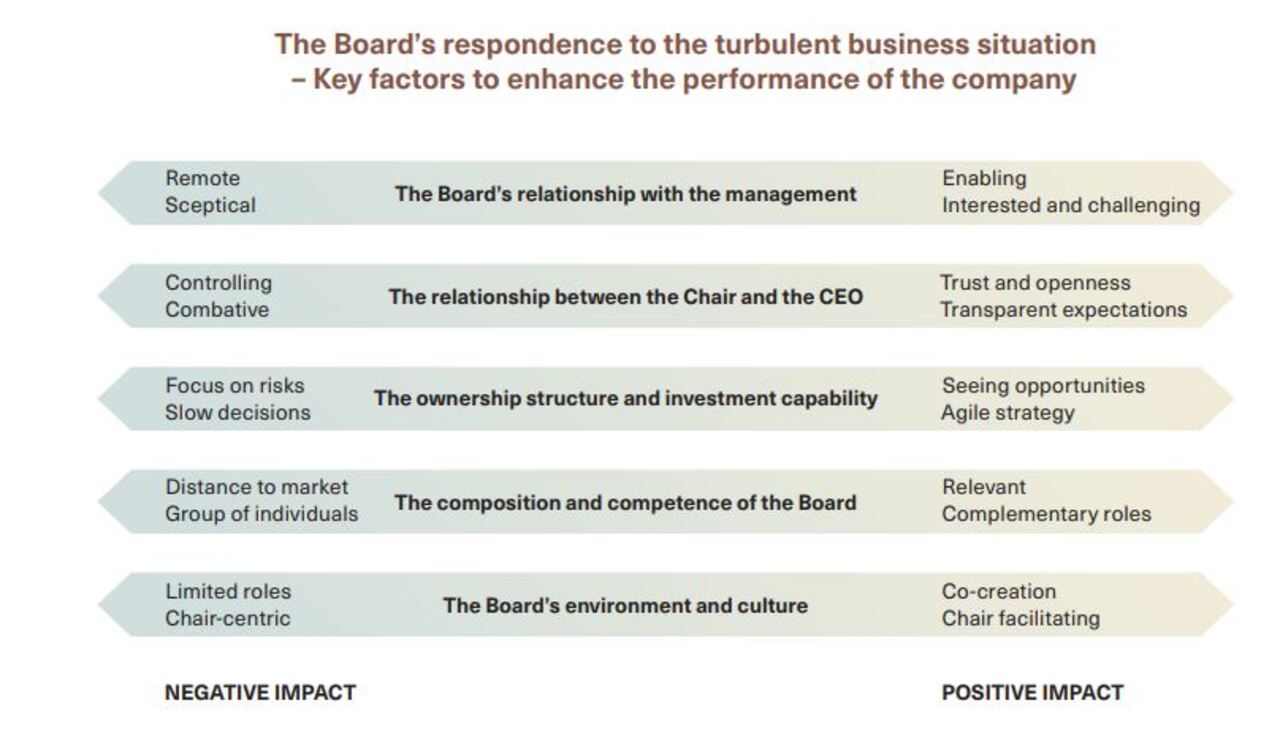
A clear communication of owner’s strategy gives the board, especially the Chair, guidance for their decision making. In time of turbulence, clear decision making, and willingness to take action are crucial. Being aware of the long-term commitment, willingness to invest, risk appetite and strategic considerations of the owners, the board gets a clear framework to work with.
Key traits of effective chairing
The role of the Chair has become increasingly significant in ensuring the organization’s success. Extraordinary disruption highlights the importance of the Chair’s leadership skills. Boyden has studied the Chair’s role and leadership and its effects on the company’s success. Five key traits were crystallized in the study conducted just before the Covid19, four of which were related to the Chair:
- become the enabler
- make way for inclusive collaboration,
- build beyond the boardroom
- establish a leadership culture that cultivates motivated, curious, and accountable directors.
The fifth trait pointed at the owners, proactively shaping the board composition and having an agile succession for the Chair. The importance of those traits has increased significantly.
Beyond the ownership structures, when the Chair builds the leadership culture on clear governance and leads with her own example the company tends to perform better and attract new talent to the board and operative levels.
The best Chairs avoid informational asymmetry between the top management and the The Boards with transparent governance tend to be more performing, and fair play companies tend to attract and ultimately retain better directors and also executives. – Ludo Van der Heyden, Professor of Technology and Operations Management; The INSEAD Chaired Professor of Corporate Governance shareholders by maintaining a transparent and accountable relationship with all stakeholders.
Essential for the Chair is to create a leadership environment where decisions are made with the highest possible understanding of matters at hand. This type of leadership environment pushes the CEO to bring forth more diversity and points of view beyond the typical operational managers and financial executives. With extensive information, the board can challenge and support the CEO as needed. By shattering the hourglass mentality and admitting the legal responsibility of the role, the Chair can enhance leadership behavior towards both vertical directions.
To ensure that the board adds value in extraordinary disruption and beyond, the Chair should monitor the pulse of the board constantly and evaluate the board’s practices and competencies, accordingly, reviewing results with the owners for consideration – considering contextual factors such as time and culture.
References:
1) Boards in challenging times: Extraordinary disruptions; Alvarez & Marsal and Henley Business School, 2022.
2) Presentation of Mr. Andrew Kakabadse, Professor of Governance & Leadership at Henley Business School, in DIF’s seminar “Boards adding value and defending reputation in great turbulence” on September 1st, 2022 at the British Embassy in Helsinki, Finland.
3) Modernizing The Mindsets Of Board Chairs; Lahti, Carita & Panula, Nelli, Boardview 12/2019.
4) Setting a tone of Fairness at the Top By; Ludo Van der Heyden Business Compliance, INSEAD 05/2013
Featured Partners