This article was originally published on the Wall Street Journal’s website. Click Here to view the original article.
Pressure from investors and lawmakers to boost gender diversity in the executive ranks and the boardroom are prompting more companies to consider a wider array of C-suite candidates and, increasingly, tie performance reviews and pay to hiring targets.
“Diversity is necessary to drive above-market performance,” said Charlotte Simonelli, finance chief at Realogy Holdings Corp. , a residential real estate-services firm. “And companies that do not focus on both diversity and inclusion undercut themselves by dismissing a broader set of experiences and viewpoints that can help them get to even better answers, faster.”
A recent study by S&P Global Markets Intelligence confirms her view. It found that companies with female chief financial officers are more profitable than those without. The study examined the largest 3,000 U.S. companies from 2002 to mid-2019. Those companies saw a 6.2% increase in profitability during the first 24 months after the appointment of a female CFO, compared with those with male finance chiefs.
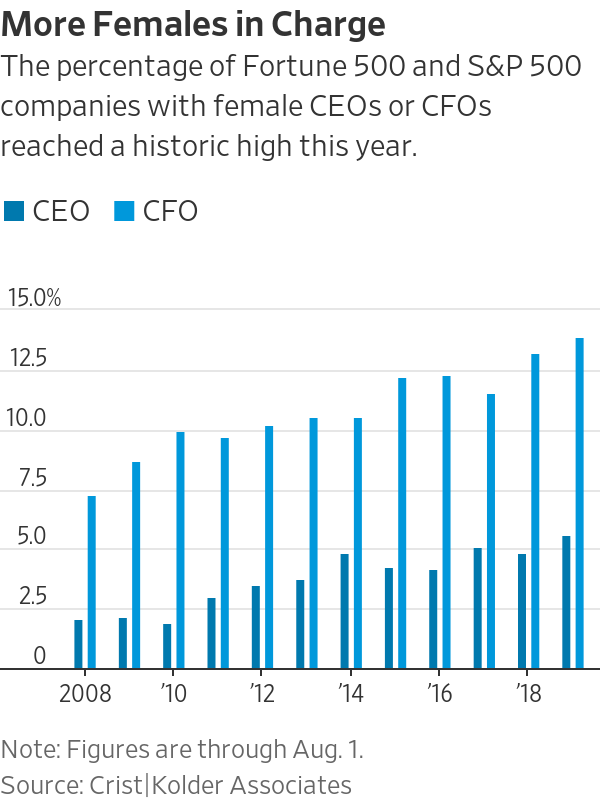
Still, the number of female executives at large U.S. companies is quite low. In 2018, 12.8% of CFOs of Fortune 500 companies were women, according to data from Spencer Stuart. During that year, only 9% of companies in the Fortune 500 appointed female CEOs, according to the recruiting firm.
That’s changing as more investors insist on diverse executive teams, and as regulators weigh in. California last year passed a law mandating that all public companies with headquarters in the state have at least one woman on their boards by the end of this year—a decision that is expected to influence boardrooms and C-suites across the country.
Sixteen percent of CFO appointments in the Fortune 500 since the beginning of the year—13 out of 80—have been female, Spencer Stuart data show. For CEOs, the percentage figure is the same, with 9 of 57 CEO roles going to women.
Recruiters say companies in the past year have increasingly requested more diverse candidates. Meanwhile, more companies are setting internal recruitment and promotion targets that promote diversity.