Articles & Papers

The New Essentials of Executive Onboarding

A Reference Guide to Creating an Exceptional Virtual Experience

By Nick Chambers

Virtually onboarding a leader is a new process for many organizations but one that is increasingly necessary given office closures and travel restrictions resulting from COVID-19. That which was traditionally accomplished through face-to-face orientations, tours, tagging along to meetings, lunches, coffees, and impromptu check-ins requires a different approach when the leader lacks in-person access to their new colleagues.

An efficient and engaging experience for the new leader can be achieved by borrowing best practices from traditional onboarding, remote working, and even politics.


The Why: Engagement Just Got Much Harder

What happens naturally or organically in face-to-face situations will require a greater degree of forethought and coordination. It is not difficult to imagine the consequences of getting this wrong: miscommunication, delayed productivity, dissatisfaction and so on.

As well, starting a new role can trigger a whirlwind of emotions: from excitement, to uncertainty, to full-on “imposter syndrome”. The new leader will be eager to make a positive first impression, prove to themselves or others that they made the right decision, develop new relationships, and/or get on with what they were hired to do.

These emotions can be exacerbated and ambitions frustrated when the new leader is isolated from their colleagues. Physical isolation leads to social isolation and all of the accompanying complexities. Building rapport, establishing credibility, demonstrating authenticity, earning trust and receiving feedback (verbal or non-verbal) are much more challenging for the new leader to achieve.

To maximize engagement and a positive onboarding experience, these challenges need to be anticipated and planned for. And the new leader should be given every opportunity possible to connect with others and articulate their needs.

The What: Onboarding Content

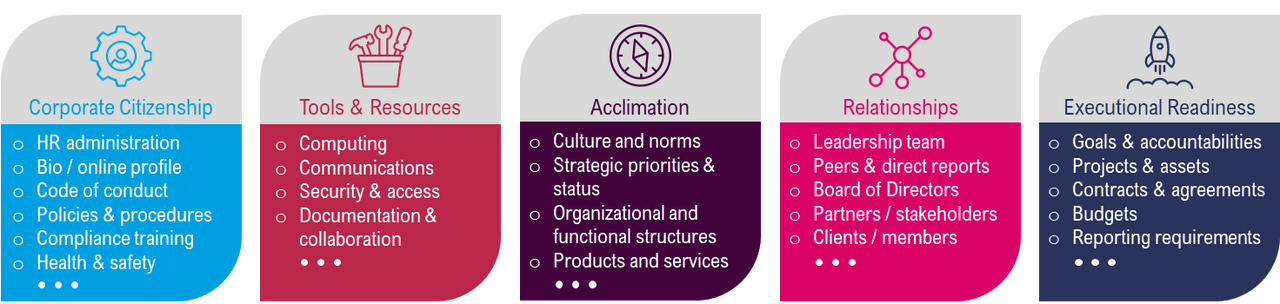
The what of the virtual onboarding process should be familiar to most. The new leader will need to complete administrative, security and compliance requirements; obtain access to tools and resources; acclimatize themselves to the organization; meet others and develop relationships; and prepare to start executing.
The How

Part I: Onboarding Process and Tactics

To reflect workplace culture, each organization will have a different look and feel to their onboarding process. As you adapt yours to the virtual space, here are some questions to consider:

  • What would it look like to co-design the onboarding experience with the new leader? Doing so would help them engage and feel less at the mercy of factors and decision-making outside of their control (and line of sight).
  • How can you leverage meeting technology to replace the customary welcome reception? Who will coordinate it?
  • What resources should go into a personalized onboarding portal for the new leader to access?
  • How will you announce their arrival, beyond an email blast? How will you engage the new leader in these communications? What balance of formal and informal virtual touch points set the tone for your team culture?
  • Who are their key contacts and champions? Who will make these introductions?
  • What are the new leader’s communication preferences?

Part II: Transition Team Approach

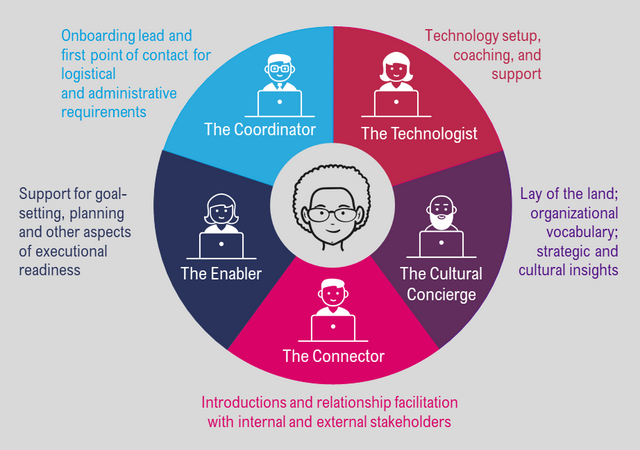
It is customary for newly elected political leaders to appoint transition teams to provide guidance and support as the leader ramps up. Each member of the team is responsible for a specific portfolio and/or set of responsibilities. Many organizations outside of the political arena already follow a similar, often less formalized, approach to onboarding new leaders.

In the virtual scenario, the formalization of a team-based onboarding approach is key to keeping the new leader engaged and productive. It also sends a strong signal that the organization is taking the appointment seriously and is well organized.

Here’s how to do it:

  • Treat the Coordinator as a project manager, with responsibility for holding the pieces of the process together.
  • Move quickly on technology setup, sending pre-configured hardware by priority courier, and providing white-glove tech support until the leader is up and running independently.
  • Invite the leader to provide input into the composition of the team and elements of the process.
  • Consider whether team members can or should have multiple portfolios e.g. Connector and Cultural Concierge, or whether a portfolio requires multiple people.
  • Create an onboarding plan with key activities, milestones, and team composition.
  • Convene a quick team welcome huddle with the new leader. This may be the only time the whole team needs to meet but even a single meeting sends a positive signal of support.
  • Decide how often each member of the team should proactively check in with the leader and have them add reminders to their calendars.
  • Adapt the plan as the process progresses. Don’t expect to get it perfect at the outset. Be transparent with the new leader that you are deliberately taking an agile approach.

Access / Download the PDF here.

About the Author

Nick Chambers
Nick Chambers
Partner, Leadership Consulting, Canada

Nick Chambers brings a fresh approach to executive recruitment, combining his expertise in leadership development, organization performance consulting, board governance, and client service. Nick is adept at aligning strategic executive talent insights and solutions to the specific needs of his clients. He is passionate about the social impact sector, and the critical role of higher education, healthcare, and not-for-profit institutions in creating vibrant communities and societies. He is a champion of diversity, equity, and inclusion in all of its forms.

This website uses cookies to ensure you get the best experience on our website. Learn more