Boyden: What has been the Irish Food Board’s approach to dealing with the challenges of the COVID-19 crisis?
McCarthy: We are working closely with the government, specifically the Department of Agriculture, Food and the Marine, the Department of Health and others, as part of the overall government response.
At the same time, internally, we’re implementing a continuity plan that will allow us to keep providing essential services, both in Ireland and through our 14 international offices. Of course part of our response is to take every precaution to protect our staff and our clients. We are doubling down on that. We see ourselves as taking the lead, in that our members are responsible for ensuring that the country’s food is safe and that it continues to be quality assured. That also means making sure that it continues to be available. There is a lot of sensitivity around both food safety and availability.
Internationally, we are adhering to the guidelines of local authorities, as well as the Department of Foreign Affairs and our embassies and consulates in each market. In places that are under quarantine, our teams are working remotely. Our international teams are also tasked with collecting local market data, looking at the changes unfolding in customer demand and consumption patterns, and adapting to that.
Boyden: What changes are being implemented in terms of process and supply chain to overcome the crisis?
McCarthy: One of the main areas where we’re making changes is our audits. They are continuing, but if a farmer, a grower or processor believes their operation may have been exposed to the virus, the audit can be postponed and their certification will be extended for 60 days. Also we are not doing any unannounced audits. For the audits that are taking place, we have developed a strict set of biosecurity guidelines for our auditors to follow.
Also, going back to the international front, we are adapting to changes in terms of logistics and supply chain issues, which we’re keeping a close eye on. We have committed ourselves to providing very up-to-date information to our producers, as much as possible, especially if they ship internationally. We want to make sure they have the right information and insights they need to make the right decisions, regardless of how fast things change and shift course. That’s a major focus.
The other important piece, which also informs our overall approach, is to respond to the changing situation in real time, as the government places restrictions on movement and on commercial activities. We are keeping our focus on our mission, and that means being agile and adapting to the situation – whether it’s cancelling a promotional event or changing the media we use to communicate. There are a lot of touchpoints.
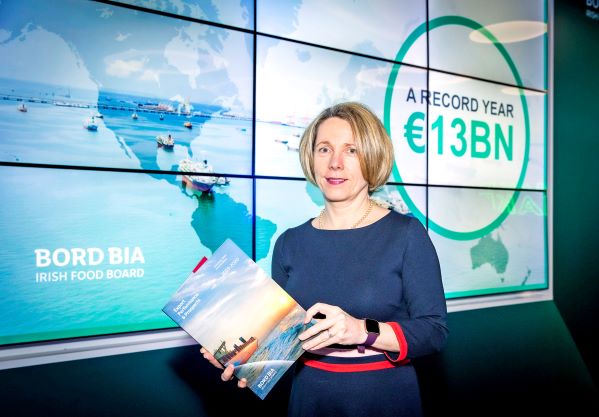
Boyden: The Irish food and drink industry has expanded greatly in recent years, with Irish products now being sold in over 180 markets worldwide with a total export value of €13 billion in 2019. Why do you think this is and what makes the industry unique?
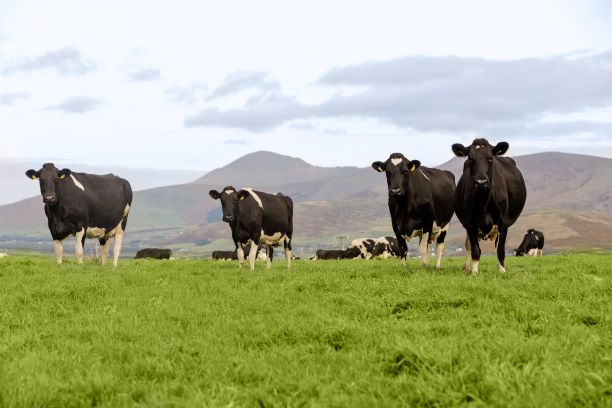
McCarthy: The agrifood industry is Ireland's most important indigenous industry. You could say that we haven't been blessed with huge natural resources like oil or diamonds or gas or anything like that. We've been blessed with a climate which allows us to grow grass, and that's the key ingredient of Ireland's food and drink industry.
In 2009 - 2010 there was a strategic review done of the Irish food industry. The whole globe was in a difficult place, and that was one of the big drivers of Ireland calling itself out to say ‘What is our agrifood plan?’. In 2010 it created an agrifood strategy, a 10-year plan that’s updated every five years.
This plan, Food Harvest 2020, called for the creation of a food brand for Ireland. To me that was a key impetus to the success that the industry has been enjoying. It's very hard to create a brand in the first place, but even more difficult to capture the essence of a country.
What does Ireland and its food industry stand for? When we spoke about what the food brand of Ireland actually meant to people, we asked them to try and relate it to a food or even a cuisine. The feedback was surprising. We were told it evoked images like Japanese sushi. We asked ‘Why? Why would you consider that for Ireland?’ The view was ‘it’s so natural, we could eat it raw.’ That was the fundamental insight that allowed us to build our messages around the naturalness of the food and look at the health and wellness agenda that was starting to emerge.
Boyden: How has the Irish food industry adapted to the expectations of sustainability?
McCarthy: Sustainability is the big issue today. We started to proactively work on the drive towards natural and the importance of sustainability back in 2010. We married two assets, our natural credentials and a pioneering sustainability programme called Origin Green.
What Origin Green looks to do is create proof points for customers and consumers behind the Irish food industry brand. From our perspective, when we look at our customers and consumers, it's our reputation that they're buying as much as the taste of our food products.
In a world where it's very hard to believe or trust or have sources of information that you can absolutely make decisions on, what this programme promised to do was to be an independently accredited programme that was science based, improvement led, and looked to have 100% of Irish food involved in it. Today, Origin Green is the programme we use to underpin 90% of our food and drink exports.
Boyden: Under your guidance, the Irish Food Board has helped promote the growth of Irish food and drink exports in a commercially tangible and sustainable way. What has helped guide your approach?
McCarthy: We have a unique sustainability infrastructure. There's no other country in the world doing this type of work on a national basis like Ireland.
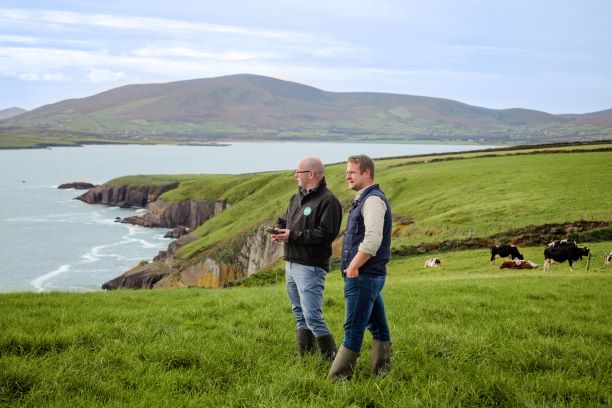
We have 96% of our dairy farmers and 90% of our beef exports signed up to this programme. We audit their farms nationally every 18 months, and based on that audit, we carbon footprint each individual farm. We're able to then give information back to the farmer on how to improve. Today we have over 200,000 carbon footprint assessments on individual farms. We can then compare one farm to similar farms from a size perspective, a geographic perspective, etc. That data set is unique to Ireland.
In February 2020 we launched a verified grass-based system from Ireland using this infrastructure. Now we have a system that's independently accredited that allows our processors to put a verified grass-fed badge on their eligible dairy products.
Boyden: How important do you feel reputation is for organizations in the food and drink industry and what does the Irish Food Board do to build and reinforce trust with different stakeholders?
McCarthy: Everything we do is insight led, so we're looking continuously towards the market, and we're very conscious of the voracious appetite that consumers have for accredited data sets. We fundamentally believe that there's a huge connection between reputation and trust, and trust and proof points. When we communicate we always have the fantastic photos and green images of Ireland that bring our country to life but our proof is the transparency of the data.
A further significant part of our work is diving into insight at the consumer level, and translating that insight to ensure that we have the correct data sets to allow our customers to meet that consumer need. Whether that's on the move towards natural, or answers to questions like ‘How is this benefiting my health?’ or ‘How is that animal treated? What does that animal eat?’ What we're now looking to do is create the proof points to allow our customers to have that trust.