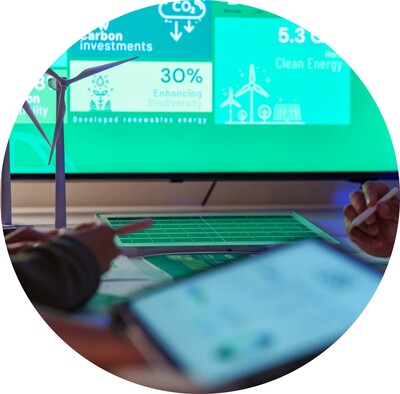

The shifting landscape: towards a ‘social value economy’
"The modern economy and traditional corporate structures have, until recently, been designed to ‘do well’ but not necessarily to ‘do good.’ That’s changing. Organizations are maturing and increasingly view their role, at least in part, as an active ingredient for repairing our world. Through our counsel with leading organizations and our commitment to multiple ‘bottom lines,’ we’re proud to be part of this essential and positive shift."
Kathryn Young
Managing Partner, Canada
- The first global social enterprise census has been published by Social Enterprise UK and the British Council, an international organisation for cultural relations and educational opportunities, revealing “one of the largest movements of our time” in the shape of an estimated 11 million social enterprises – businesses driven by a social or environmental purpose.
- There is no leader or figurehead for social enterprise; instead, Francois Bonnici, head of social innovation at the World Economic Forum who wrote the foreword to the census, says it is driven by people “developing the kind of companies we need in the 21st Century”. These companies are promoting the concept of social value across the corporate landscape, with social and environmental issues no longer the preserve of the social impact sector.
- PwC defines ‘social value’ as “the impact an organisation has on society. It considers the economy, environment and people as one ecosystem which needs to thrive together”.
- While social value was born in the public sector, it is now gaining traction in the private sector. A Bain & Co. survey shows out of 300 global cross sector CEOs, 85 percent view social issues as urgent concerns for their business; 60 percent say its primary role is either to create “positive outcomes for society” or “balance the needs of all stakeholders.” The moral obligation of corporate social responsibility (CSR) has morphed into a charter for enterprise, with social value at its heart.
- Moreover, social value has been passed into legislation in the UK, with the Public Services (Social Value) Act 2012 and Procurement Act 2023 designed to create a ‘social value economy’.
- Building on this, the ‘Social Value 2032 Roadmap’ is an innovative programme led by Social Enterprise UK, in partnership with global companies Jacobs, PwC, Shaw Trust, Siemens and SUEZ recycling and recovery UK. The programme aims to make social value cover all public procurement, worth around £400 billion1, and influence spending in the largest private companies, accounting for 20 percent of UK GDP.
- Other countries such as the Republic of Ireland, Canada and Australia are moving towards embedding social value into procurement legislation.
"Social impact organizations demand an inclusive, holistic style of leadership. Their leaders have learned to master the complex balance between financial returns and social and environmental benefits. These leaders go beyond simply sparking change; they serve as role models for the broader economy, which is undergoing a profound shift toward a value-based model that creates benefits not only for shareholders, but also for customers, employees, society, and the environment as a whole."
Christian Watts
Managing Partner, Switzerland
The need for social value drives convergence
- Social value has become synonymous with corporate sustainability. “The companies that lead on social issues, such as DEI and socially responsible supply chain practices, don’t view these efforts solely as risk mitigation,” said Karthik Venkataraman, a partner in Bain’s Diversity, Equity, & Inclusion practice. “It’s the opposite, in fact. The leaders in this space have found ways to directly tie their social efforts to the commercial logic of their businesses, opening new opportunities for value creation by better serving all of their stakeholders. They see a symbiotic relationship between the concepts of ‘doing well’ and ‘doing good.’”
- How do we quantify the commercial element of social value? In a first-of-its-kind data review, The World Economic Forum’s (WEF) State of Social Enterprise report estimates there are 10 million social enterprises globally, generating approximately US$2 trillion in annual revenue and creating nearly 200 million jobs. This is close to the global apparel industry, valued at US$1.79 trillion2 and almost twice the size of the US$1.01 trillion3 advertising industry.
- In a volatile political and economic environment, people – employees, consumers, stakeholders and fragile communities – are looking to the public, private and third (NGO, voluntary, not-for-profit and civil) sectors to address the crises and challenges they face. The language is therefore evolving. Phrases such as ‘socially conscious leader,’ ‘purpose-driven growth,’ ‘cause marketing,’ and ‘people-first transformation’ reflect increasing recognition of the need to rebalance profit, people and planet.
- Convergence between non-profit and for-profit organisations is therefore driving a new vision for social value and the kind of leaders who can drive this change. For-profit organisations are rebalancing their approach to profit, people, and planet, driven by climate emergency, the UN’s sustainable development goals and shifting attitudes among shareholders and stakeholders. On the other hand, non-profit leaders are seeking more personal accountability.
- The greatest of these shifting attitudes is the desire among employees, particularly in Western societies, to work in organisations that have a broader sense of purpose: providing social value to employees, customers and the global population, many of whom, it is felt, face unacceptable levels of social and economic inequality.
- Convergence is therefore also driven by need. In emerging markets, the private sector is filling gaps in infrastructure and society, meeting social needs through private enterprise, while social enterprise is showing the private sector how to become more purpose/socially driven.
- Read more on the topic:
Social Enterprise UK/ and British Council: More in common – the global state of social enterprise
Pioneers Post: 11 million social enterprises worldwide
Bain Report: Making Business Do Better for Everyone
World Economic Forum/Schwab Foundation/Bertelsmann Foundation: State of Social Enterprise
Social Enterprise UK: Social Value 2032 – Creating a Social Value Economy
“There is a convergence happening: top-performing enterprises in both the not-for-profit and for-profit sectors have much to learn from each other’s best practices. Supporters of not-for-profits increasingly expect more commercial discipline in decision-making and resource deployment. Meanwhile, for-profit stakeholders are calling for a balance that integrates traditional performance metrics with investments that benefit society at large. For both sectors, this convergence points to a balanced, sustainable approach to advancing all enterprises.”
Craig Stevens
Managing Partner, United States