Featuring Marie-Hélène Gaudreault, Leader in Boyden’s Social Impact Practice
In Canada, where English and French are both official languages, bilingualism is not only a valued skill but also a legal obligation for many organizations due to strategic and regulatory requirements. Yet when it comes to the executive ranks, organizations still seem to struggle to find and attract talented, bilingual leaders who can navigate both official languages with ease and lead across cultural lines. Despite decades of policies promoting bilingualism, there remains a gap between demand and supply.
Unilingual English-speaking executives dominate the C-Suite, while bilingual leaders remain underrepresented, especially outside Québec. The result? Missed opportunities, regional disconnects, and a growing credibility gap within leadership teams across both the public and private sectors.
This article tries to narrow that gap.
For over 30 years, our firm has recruited CEOs, senior executives, and Board members to some of the country’s most prominent national and provincial organizations. In most cases, the organizations and the Search Committees have prioritized bilingualism as an important skill.
Searches for these organizations start with a discussion about the key selection criteria. And, invariably, before the Committee agrees on the criteria, someone will ask the question, “Do they need to be bilingual?” which is followed by, “How bilingual do they need to be?” followed by, “Can someone on the team represent us to French communities?”
Many organizations will concede and comprise on the degree to which a person needs to be bilingual. Usually, that concession feels less than satisfactory. In most cases, the Committee lands on, “It’s a strongly desired asset.” Or, “It’s preferred”. The rationale is often “We don’t want to limit the candidate pool or lose out on exceptional candidates who are not bilingual, or at least not in our official languages.”
For a search firm, conceding on bilingualism means broadening the candidate pool that includes unilingual candidates, which candidly, will make our work easier. What it doesn’t do is address important strategic, operational, or intrinsic needs of our clients and that is to be seen as, operate as, and engage as a truly bilingual organization.
Are we doing our clients a disservice by not addressing this issue? Are we taking the easy route, the easy way out, that benefits us and the process but not the client and the outcome? I’ve often asked myself these questions and my answers are always yes and yes. Yet, we and the Committees we serve have done little, other than hope, pray, and dream, to solve the bilingualism riddle.
This article tries to change that and make us and our clients better at landing the elusive bilingual executive. What better way to start the change than by speaking with an expert, Marie-Hélène Gaudreault?
Marie-Hélène Gaudreault is a Partner and Leader in Boyden’s Social Impact Practice. Marie-Hélène, bilingual, is widely regarded across francophone and bilingual communities as an authority in leadership and executive recruitment. She is a speaker and author of articles on the recruitment of bilingual executives, as well as on the unique challenges faced by bilingual and Francophone leaders working in a linguistic minority setting. Her article Le leadership en contexte linguistique minoritaire francophone: qualités et compétences essentielles pour les postes de haute direction is published in the anniversary issue of the journal Linguistic Minorities and Society. With a network extending across Canada and beyond, Marie-Hélène has recruited bilingual executives for over 15 years. She has collaborated with organizations such as Concordia University, the University of Ottawa, Bishop’s University, the University of Winnipeg, the University of Ottawa Heart Institute, Colleges and Institutes Canada, Montfort Hospital, the Government of New Brunswick, Teamsters Canada, and the Office of the Ombudsman of Ontario.
Introduction, by Mike Naufal, Managing Partner
Marie-Hélène is my go-to person, and the firm’s expert, on all things Francophone. One morning over coffee, I shared my frustration with her about our difficulty in finding a qualified bilingual executive for a CEO role at a national organization. Her response surprised me. While I was puzzled by the lack of candidates, she was puzzled by the problem itself.
Marie-Hélène works with bilingual and Francophone organizations every day and has spent over 15 years recruiting bilingual executives. From her perspective, the challenge didn’t quite add up. I had several questions for her, and she had just as many for me - too many for a quick conversation over a double espresso.
What follows is the transcript of that conversation, which is structured as a three-part series exploring one of Canada’s most persistent leadership challenges: the recruitment of bilingual executives.
In part one, we begin with a conversation that sparked the idea for the series - an insightful dialogue with Marie-Hélène. In part two, we’ll examine the structure and dynamics of the bilingual talent market. And in part three, we’ll explore practical strategies for organizations to attract and secure bilingual leadership talent. The goal to increase the capacity of organizations to serve Canadian populations in both official languages.
Marie-Hélène, can you tell us about your background and what led you to Executive Search?
My path to Executive Search was a bit unexpected. My first passion was linguistics. I completed a bachelor’s degree in language and communications and a Master’s in Linguistics, with a focus on sociolinguistics. I was fascinated by the idea of identifying demographic traits through language. I was intrigued by the idea of getting to know people not by what they say, but by how they say it. I was especially drawn to descriptive linguistics, by opposition to prescriptive linguistics, and the idea of listening closely to people and their communities. I loved it, but I didn’t necessarily see myself making a career out of a highly specialized linguistic issue. After my studies, I worked as a computational linguist on Antidote, a grammar and spelling correction software, which at the time was available in French only. I then moved into advertising, but again, I didn’t feel a strong sense of purpose in the work I was doing. These roles were no longer descriptive, but purely prescriptive, corrective, and it didn’t quite align with my values and interests. I didn’t like to tell people how they should write and speak but rather simply listen to them, get to know them better by the way they express themselves, and theorize what I hear.
That’s when I was approached by a headhunter I knew through mutual contacts. They offered me an opportunity to join their team, and I quickly realized how much I enjoyed it. At first, I didn’t fully grasp how well my background would serve me in this field, but in fact, it would enable me to conduct quasi-scientifically strategic research to find the right person and truly listen to people - their words and the intentions behind them. Plus, my advertising experience would enable me to position roles in a way that was compelling and attractive to candidates and represented the clients well in the market.
I advanced through two different international firms in Québec before joining Boyden, first in Montréal and then in Ottawa. That’s where I started to connect with the Franco-Ontarian communities, and others navigating life in a linguistic minority setting - and when everything started to align: my passion for sociolinguistics and my professional path came together in a way that felt both natural and deeply fulfilling.
What inspired you to specialize in Bilingual Executive Recruitment?
As a Francophone, when I moved to Ontario, I quickly realized how crucial it is to have strong bilingual leaders in a minority setting. This holds true for English speakers in Québec and for French speakers elsewhere in Canada. That move was a turning point for me. I had the opportunity to specialize in recruitment of high-caliber bilingual talent for communities in Québec, Ontario, and all across Canada. I wanted to support, among others, organizations in minority language settings and those that are truly committed to bilingualism and to help communities thrive in the language of their choice. Recruiting strong leaders is the best way to support the long-term sustainability of these organizations — and, in turn, the sustainability of minority communities. I’d now found real meaning in my work.
How difficult has it been to recruit bilingual talent over the years?
Recruiting top bilingual talent is challenging, especially outside of Québec. It takes dedication, continuous effort, and a truly strategic approach. The goal is always to find exceptional bilingual candidates without compromising on other essential qualifications. But with the right combination of strategies, we’ve had great success. My placement rate is close to 100%, and each search comes with its own set of complexities.
In Québec, where French is the majority language, there’s a larger bilingual talent pool since Francophones are often proficient in English. Outside of Québec however, in Ontario and the rest of Canada, the bilingual talent market is much smaller since the proficiency in a second language is not as common with the Anglophone communities. The pool is more limited, but we’ve developed strong strategies to build high-quality Long Lists even in these contexts. It means thinking differently, stepping outside the traditional framework, and even beyond borders. We don’t just look for a “Franco-Ontarian” in Ottawa or “Franco-Manitoban” in Winnipeg for example, we look across the country, and we include any Francophones and Francophiles. Otherwise, we’ll always end up with the same few people at the head of the organizations. Beyond language and background, we’re looking for cultural sensitivity; an understanding of what it means to navigate and grow in a minority setting. Moreover, candidates understand that mobility is often part of the equation if they want to advance their careers in such a context. Relocation is therefore a common reality.
Tell me about the Canadian bilingual landscape? Canada’s bilingual talent landscape is anything but a one-size-fits-all. While Québec is home to about 85% of the country’s Francophones, there are strong and growing French-speaking communities right across the country.
Bilingualism rates vary significantly across provinces, influencing the availability of bilingual talent for executive roles. For example, Ontario has over 530,000 Francophones from many different countries, and New Brunswick—Canada’s only officially bilingual province—has a 34% bilingualism rate. Even provinces like Alberta and British Columbia have sizable bilingual populations, with over 250,000 and 320,000 bilingual individuals respectively. The francophone population has been evolving rapidly in several regions: it is aging and becoming increasingly diverse.
What makes the bilingual talent space unique when it comes to executive recruitment?
What makes the recruitment of bilingual executives unique is that we are not simply looking for someone who can speak a second language, we’re looking for leaders who can navigate complex cultural dynamics, build trust across language lines, and represent the communities in a meaningful way.
It’s as much about cultural fluency as it is about linguistic ability. Plus, a Francophone leader operating in a predominantly Anglophone environment outside of Québec, as well as an Anglophone leader in a predominantly Francophone environment such as Québec, are often highly committed and willing to go the extra mile. Operating in a minority context typically requires additional efforts—varying depending on the specific circumstances—such as educating policymakers, advocating for representation, and defending interests to secure ongoing funding. These tasks generally do not require as much time when representing the majority, as certain realities are already understood, acknowledged, and conscious.
As mentioned before, there’s also a strong element of mobility. Many bilingual leaders outside Québec are often open to relocating to serve in other provinces or regions. That said, attracting them requires not only a competitive salary, but we need to share the right story that will resonate with them, their values, and career interests. Storytelling that resonates with the right leaders is crucial.
Ultimately, bilingual executive recruitment is not just about compliance or language quotas; it’s about finding engaging leaders who can genuinely bridge cultures, connect with diverse communities, and bring people together. And when you find the right person, the impact goes far beyond the role itself, it strengthens the whole organization and the communities it serves.
Can you speak more about that gap in leadership roles? Why do you think this shortage exists at the executive level?
First, even though about 18% of Canadians reported being able to hold a conversation in both official languages as of 2021, that doesn’t necessarily translate into bilingualism at the executive level. Being conversationally bilingual is one thing; leading teams, managing complex files, and navigating stakeholder relations in both languages requires a deeper level of fluency and cultural awareness in both official languages.
Secondly, we need to have a broader and deeper conversation about bilingualism in Canada. While we often pride ourselves on being an officially bilingual country, the reality is that our systems, including our educational systems, aren’t always fully equipped or prepared to support or develop bilingual professionals, including at the leadership level.
There’s a clear disconnect between perception and reality, especially in corporate Canada. There’s sometimes an illusion that we’re prepared, that bilingual leadership is already embedded in our institutions. But in truth, bilingual leadership remains a strategic asset, not a guarantee.
Organizations that truly invest in this bilingual leadership aren’t just checking a box; they’re actively strengthening their capacity to serve more Canadians meaningfully, and they’re setting themselves up for long-term resilience and relevance in a bilingual country.
It’s not just about speaking both official languages, it’s about understanding the culture behind them and the impact on a community if they can’t access, for example, public services such as healthcare or education services in their first language. Without that understanding and intentionality, it becomes very easy to slip into the comfort of the dominant language.
But bilingualism looks different for everyone, doesn’t it?
Absolutely. It is essential to recognize that language proficiency exists on a continuum for everyone, and that the acceptable level on this continuum should vary from one role to another. Moreover, there is a very real phenomenon known as “linguistic insecurity”. Linguistic insecurity is the discomfort or lack of confidence someone feels when using a language or language variety they perceive as inferior or nonstandard. This often happens in bilingual or multilingual settings, especially when certain languages have more prestige or institutional power.
To illustrate that: Would you feel confident juggling, and willing to do it in front of an entire crowd without dropping a single ball if you hadn’t practiced in a long time? You might hesitate, feel unsure, insecure and, yes, you might drop a ball at some point. The same applies to language. To maintain or reach proficiency, it needs to be used regularly, even if it is your first language, which is not always doable for all Francophones across Canada, even if French is their first language. Thus, when you are invited to apply for a bilingual position—where you will be expected to lead meetings, speak publicly, and so on—you may decline out of fear of not meeting the expectations in either of the official languages. You might feel that you are not sufficiently qualified, and the fear of making mistakes could lead you to shy away from taking on a leadership role even though you are qualified. From my perspective, such an opportunity would allow you to strengthen your language skills and contribute to expanding the ranks of bilingual leaders in Canada.
I often hear during recruitment processes, "We would like to have a true Francophone." My recommendation is to avoid this kind of stereotypical assumption. Let’s avoid stigmatizing “mistakes” that deviate from the prescribed standard. A person’s way of speaking may carry regional influences or differ from so-called standard norms, but that in no way diminishes their leadership capabilities. In fact, these individuals may be deeply rooted in their communities, bringing a wealth of lived experience and are exceptional leaders with high potential.
Additionally, Francophone communities in Canada are incredibly diverse, reflecting a wide range of cultural, regional, and linguistic backgrounds. Many Francophones in Canada are of African, Caribbean, Middle Eastern, European, or Southeast Asian descent, each bringing their own unique linguistic nuances, traditions, and lived experiences. This rich diversity adds depth and dynamism to the francophone communities and highlights the importance of inclusive, culturally responsive approaches when engaging with Francophone and bilingual talent and communities.
I understand that for certain roles, such as a CEO position within some francophone organizations, a high level of French proficiency is required, particularly for reasons of credibility. However, this is not the case for all leadership positions and yet, the stereotype remains too often. For many leadership positions, we should be able to move away from narrow definitions of bilingualism that prioritize perfection over impact. We need to ask ourselves, “What level of bilingualism is required for this position, and how can we support the new incumbent to improve?”. Once we set the non-negotiable minimum level required in both official languages, fluency comes in many forms, and leadership is not measured solely by accent or vocabulary. What matters most is the sensitivity to others is the ability to connect, to be understood, and to inspire trust in both official languages. When organizations embrace this broader perspective, they open the door to a richer and more diverse pool of qualified bilingual talent.
We’re seeing positive developments in that direction at the university level, where greater access to post-secondary education in French is granted to give an equitable access to education to individuals with linguistic insecurity. Some of the more progressive institutions in Canada in that regard no longer require a language test, for example, as a prerequisite for admission, supporting the emergence of new bilingual leaders and eventually, the reinforcement of their bilingual capacities. These institutions are becoming more inclusive, and that helps foster confidence and retention among Francophone students and professionals alike. It’s about creating pathways, not barriers—acknowledging that bilingualism is dynamic and evolving, and that leaders can grow their skills, any skills including language, and deepen their impact over time. It’s also an opportunity for minority groups to live, grow in their own language, and keep their communities dynamic.
Why Bilingualism is a Strategic Asset for any organization today in Canada?
Bilingualism brings a real edge in today’s business environment. Leaders who speak both English and French are in a much stronger position to engage with Canada’s diverse markets. They’re better equipped to build relationships, communicate clearly, and understand the cultural context of the communities they’re working with. This naturally enhances customer satisfaction and opens up new business opportunities, especially in bilingual regions.
In some sectors, like federal government contracting, bilingualism of service providers is more than just an advantage; it’s often a requirement. Organizations that already operate in both official languages are more competitive and better positioned to win contracts.
And given the current political climate in the U.S., there’s a growing interest within Canada to build stronger internal alliances and increase interprovincial trade. That inevitably means engaging with bilingual provinces and Francophone partners. More than ever, having bilingual leaders and organizations is a real strategic advantage, not just for forming partnerships, but for delivering services and connecting meaningfully with a broader Canadian market.
Beyond the business benefits, there’s also a significant cultural and political dimension. Canada’s identity is deeply tied to its two official languages and understanding both linguistic communities helps foster stronger internal communication and public trust. This is particularly important when working with Francophone communities, where cultural nuance plays a big role in how organizations are perceived.
What is unique about recruiting bilingual executives outside of Québec?
Of course, as soon as you add language requirements into the mix, things become more complex. You really need to develop targeted strategies to build strong, diverse Long Lists, even more so in minority-language contexts.
Outside of Québec, expanding the bilingual talent pool sometimes means recruiting based on potential and focusing on transferable skills. That doesn’t mean lowering the bar, it means being more creative and open. You must be persistent, detail-oriented, and very systematic in your approach. The Selection Committee requires more structured guidance, which calls for increased education on our part and encouraging them to minimize, as much as possible, the influence of implicit biases in their candidate evaluation process.
We need to adopt a process that’s as systematic, scientific, and objective as possible. Without that structure, we open the door to unfair and inaccurate assessments, especially when biases like "affinity bias" creep in, favoring candidates who feel familiar or likable for reasons unrelated to their actual qualifications. Worse, we risk overlooking exceptional talent or even selecting the wrong person for the job. Unconscious beliefs or stereotypical ideas about what a successful leader looks like can shape how candidates are perceived—often without anyone realizing it. That’s why it’s critical to focus on everyone’s merits, rather than comparing candidates directly against one another. Structured evaluations, clear rubrics, and deliberate mechanisms to mitigate the effects of implicit bias aren’t just good practices, they’re essential for equity, especially in hiring contexts that already carry additional complexity and where missing out on a qualified candidate is not an option.
How can organizations attract and recruit top bilingual talent when a position becomes available?
For committed bilingual organizations, attracting top bilingual talent starts with intention and authenticity. The first step is simple yet often overlooked: post your job advertisement and position description in both official languages. This immediately signals your commitment to bilingualism and inclusivity. Ideally, your hiring process should reflect the same approach. If possible, alternate between English and French during the interviews. It sends a strong message that bilingualism isn’t just a line in the job description, it’s a lived value in your organization. Make sure your website is also in both official languages.
There are specialized Francophone channels that can help amplify your reach. For example, the Assemblée de la Francophonie de l’Ontario (AFO) is a key platform, and job postings are free. If you’re recruiting legal professionals, the Association des juristes d’expression française de l’Ontario (AJEFO) and Association des juristes d’expression française du Manitoba (AJEFM) are great resources.
If you’re doing direct outreach, headhunting, for instance, personalization is key. Always address candidates by name and begin your message, at least the greeting and the first paragraph, in their first language. You can switch afterwards if needed, but starting in their preferred language sets the right tone.
Networking is also essential. It’s not just local, it extends across provinces, especially for leadership roles. Tapping into francophone communities outside of Québec is one of the most effective ways to recruit bilingual leaders. In a limited talent pool, word-of-mouth and professional referrals from in-house employees can also be highly effective, especially within close-knit communities.
When you’re engaging with potential candidates, go beyond the typical job posting and interview. Offer an experience, invite them to visit your workplace, meet future colleagues, and get a feel for the culture. These kinds of gestures can make all the difference, especially in competitive talent markets.
Lastly, organizations benefit from being proactive in identifying talent, that is, maintaining a network of high-potential professionals whom you can invite to apply when opportunities arise. This approach requires more effort, but informational or courtesy interviews can be a useful tool in this regard.
How can you position your organization as a bilingual-friendly workplace?
That’s where employer branding comes in. Building a reputation as a bilingual-friendly organization doesn’t happen overnight, but there are several practical steps you can take that make a real difference.
First and foremost, ensure your internal and external communications are bilingual wherever possible. This creates a welcoming environment and demonstrates that both languages are valued and integrated into your organizational culture. Share your initiatives and success stories across various social media platforms to enhance your brand presence in both official languages.
You can also increase your visibility through partnerships, by sponsoring or hosting bilingual events, or even offering scholarships in the name of your organization at flagship institutions within the targeted communities. Make sure your logo is visible and associated with initiatives that matter to the target communities.
Above all, never underestimate the power of influence of your current team members, whether in building your organization’s reputation in the marketplace or in recruiting. They are your best ambassadors. When they feel valued, supported, and included, they naturally become enthusiastic advocates for your organizational culture.
By being intentional, respectful, and proactive, you not only attract bilingual talent, you build long-term trust and become a magnet for top-tier candidates who truly reflect Canada’s linguistic and cultural diversity.
How can organizations cultivate enthusiastic bilingual ambassadors?
Valuing bilingualism isn’t just about hiring someone who speaks both official languages. It’s about fostering a workplace where linguistic diversity is seen as an asset, not an exception or a limitation. And while many of these strategies benefit bilingual individuals, they’re also good practice for creating an inclusive and engaging environment for all employees. In a mature, bilingual workplace environment, such as Concordia University and University of Ottawa, everyone has the right and the confidence to work, contribute, and lead in their preferred language. They are also allowed to make mistakes. It’s not just a policy; it’s embedded in the culture.
When the second language is treated as an added value rather than an obstacle, employees feel seen and empowered. A simple gesture, like asking everyone on the team to greet a new colleague with a warm “Bonjour” or “Good Morning” can go a long way. These small gestures build respect, engagement, and a sense of belonging, signal openness, and begin to normalize bilingualism in the workplace. Fostering open communication is equally important. Encourage everyone to contribute their unique perspective to the development of policies or the launch of new initiatives. Each viewpoint is valuable, and when individuals feel that their voice is genuinely heard, they are more likely to engage deeply with the organization’s mission.
A great way to support this sense of belonging from the start is through mentorship. During onboarding, pair new hires with a mentor, ideally from another team or department, to help them navigate both the organizational structure and its culture. It creates early connections, fosters trust, and shows that you’re committed to their long-term success.
Recognition also plays a major role. Celebrate when someone improves their second language, French or English. Acknowledging progress, not just perfection, helps to create a culture where learning and continuous improvement are embraced and where bilingualism becomes part of everyone’s development journey.
To truly cultivate ambassadors, employees need to feel they belong and they are supported, paired with a sense of purpose and pride in their work. This includes providing opportunities for career advancement and leadership development. Bilingual employees who feel valued and envision a future for themselves within your organization are more likely to become advocates and help bring others along.
Ultimately, cultivating strong bilingual ambassadors is a concerted effort. It requires a holistic approach: a blend of cultural sensitivity, inclusive practices, and a clear commitment to recognizing and valuing language skills.
To conclude, what advice would you give an organization looking for bilingual executives?
Finding strong bilingual leaders, especially in minority-language settings, takes more than just posting a job ad. It requires a thoughtful approach and a willingness to look beyond the usual channels. The talent is out there, but it often exists outside of traditional networks. That means we have to rethink not only who we’re looking for, but also how we go about the search. It’s also about challenging our assumptions - being open to different accents, language levels, and backgrounds. Ultimately, we’re not just hiring for fluency - we’re hiring for leadership, insight, and authenticity across cultures.
Creating the right environment for bilingual executives to thrive is just as important. If someone constantly feels like the in-house translator or like they don’t fully belong, it’s hard for them to do their best work - or to stay long-term. Language should be a tool that helps people lead, not a burden they carry alone. That means offering tools and support, like mentorship and second language development opportunities, and building a workplace culture where diverse linguistic identities are genuinely valued. Ensure that your actions align with your messages and intentions; this consistency will strengthen your credibility and the trust placed in you as an employer of choice.
Lastly, building a strong bilingual leadership team is not a one-off effort, it’s a long-term investment. It starts with widening the search to include underrepresented communities and atypical backgrounds and continues by creating leadership development pathways earlier in people’s careers. Boards and HR teams need to make bilingualism part of how they think about succession planning and leadership potential - not as an extra, but as a “nuanced” core skill. When we treat bilingualism as leadership strength rather than just a requirement, we unlock greater performance, trust, and resilience. That’s how we build organizations that reflect the country - and are ready for what’s next.
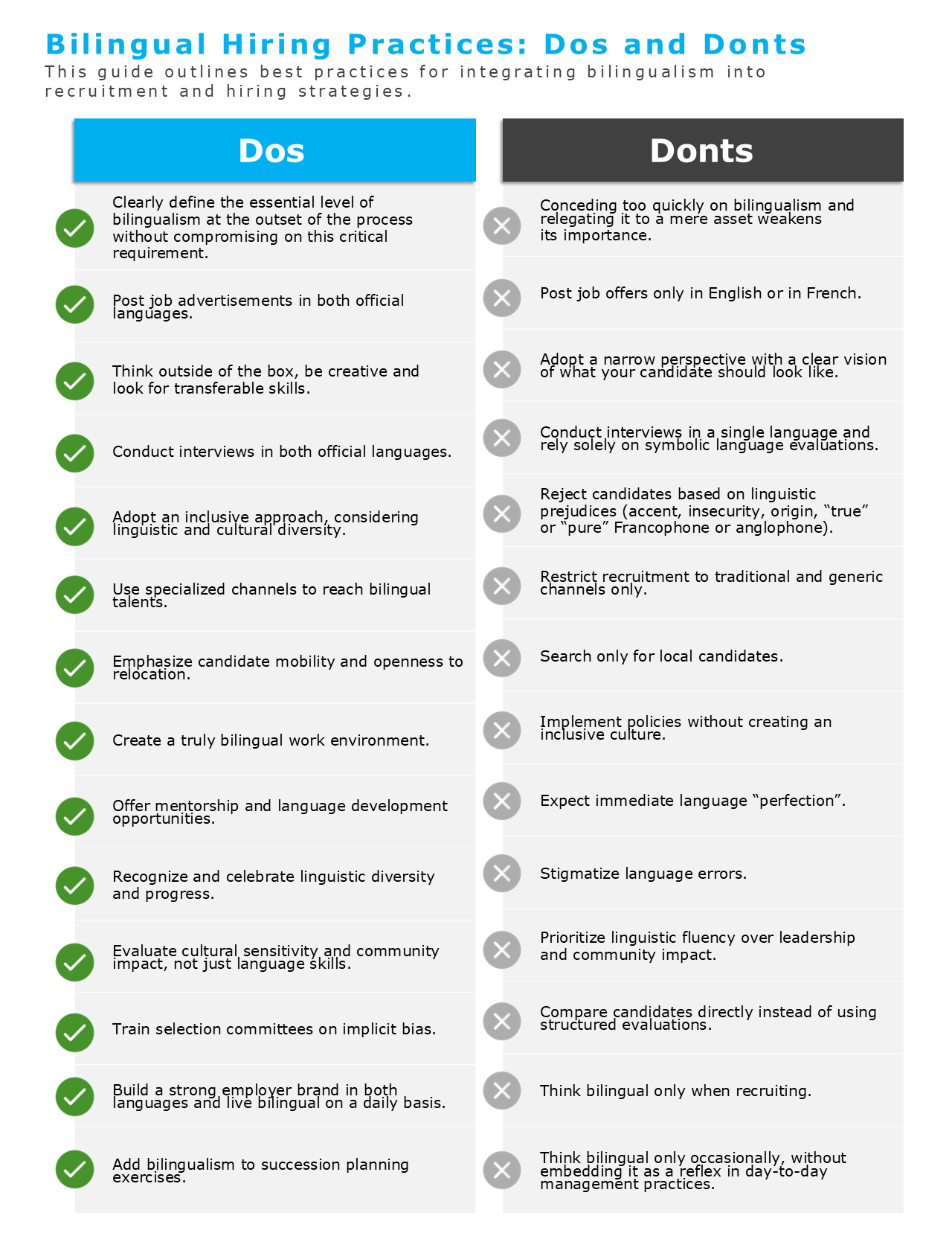
Dos and don’ts
To help organizations navigate these important processes of recruiting bilingual leaders, the following table outlines key best practices (“Dos”) and common pitfalls to avoid (“Don’ts”). By following these guidelines, organizations can strengthen their ability to attract, assess, and retain top bilingual leadership talent, ensuring long-term success and greater community impact.
Marie-Hélène Gaudreault, M.A.
Partner, Boyden Ontario Inc.
613 791-6355
mgaudreault@boyden.com