Mid-cap industrial companies hold a structural leadership advantage in volatile markets. Operating at a scale where executives remain close to operations, they combine the coordinated responsiveness of a smaller organization with sufficient operational depth to manage complexity.
This balance—judgment at the source, aligned quickly across functions—is what makes mid-caps right-sized for uncertainty.
The industrial landscape is strewn with obstacles. Tariff realignments, geopolitical fragmentation, energy cost pressures, and supply-chain reconfiguration create a volatile atmosphere for doing business. Many companies look for solutions through scaling upward to gain the apparent stability of size.
But scale can be a liability as much as an asset. Mid-cap industrial organizations are finding that they are right-sized for volatility. They aren’t immune to disruption, but their leadership model allows them to respond to it with a clarity, speed, and directness that larger enterprises often cannot match.
This article explores why that advantage exists, what it demands of the leaders who carry it, and where the pitfalls lie for those who fail to fully claim it.
The Volatility Context: Why This Moment Matters for Industrial Mid-Caps
To appreciate the mid-cap advantage, it helps to understand the current environment.
The industrial sector is absorbing a cascade of shocks simultaneously. According to the McKinsey 2025 Supply Chain Risk Survey, 82% of companies reported being directly affected by tariffs, with machinery, automotive components, and engineered goods among the most exposed categories.
In Europe, home to many of the world's most competitive industrial mid-caps, the challenge is particularly acute. Most EU goods exports now face a 15% tariff rate to the United States, the largest and most strategically significant market for Germany's Mittelstand and France's ETI (entreprises de taille intermédiaire). The effects on export-dependent manufacturers have been swift and significant.
The EY European Economic Outlook (March 2026) projects that tariffs could reduce GDP by 0.5 percentage points in the EU for 2026.
Beyond tariffs, eEnergy costs, especially in Germany and Central Europe, continue to compress margins. Geopolitical tensions in the Strait of Hormuz, Eastern Europe and elsewhere are forcing executives to reconsider supply geography—often with significant capital implications and compressed decision timelines. And digital transformation, long a discretionary priority, has become a competitive imperative, because companies that delay could fall behind peers in efficiency and customer responsiveness.
For larger multinationals, these pressures typically translate into complex strategic reviews and cross-divisional task forces. Mid-cap industrial organizations must respond decisively with smaller leadership teams, leaner functional resources, and less tolerance for prolonged uncertainty.
Those constraints, however, can be the source of their competitive edge.
Leadership roles are becoming more integrated and less siloed. CEOs must take active ownership of transformation agendas.
Elizabeth Garforth
Global Co-Leader, Industrial Practice
Right-Sized for Judgment: The Core Structural Advantage
In large organizations, the many layers of management can muffle the signal between market reality and strategic decisions by leaders. In fact, two-thirds of the business leaders surveyed for the 2026 McKinsey and Company State of Organization reports said their organizations are too complex.
At mid-cap organizations, leaders are closer to the inputs for and the results of their decisions. There is less filtering of information through governance frameworks, escalation protocols, and consensus-building rituals.
“Leadership roles are becoming more integrated and less siloed,” observes Elizabeth Garforth, Boyden Managing Partner, France, Global Practice Co-Leader, Industrial, Global Sector Co-Leader, Aerospace & Defense. “CEOs must take active ownership of transformation agendas.”
A CEO or COO for a mid-cap manufacturer can engage directly with a key customer, walk a production floor, or call a supply-chain partner with an immediacy that is not available to their counterparts at large, matrixed organizations. This proximity enables what might be called judgment at the source: the capacity to interpret imperfect, real-time information and act without waiting for analytical consensus.
When leaders are closer to operations, customers, and market signals, they are:
- Better positioned to distinguish genuine inflection points from noise.
- Less likely to overcorrect on temporary shocks.
- More likely to identify shifts that deserve strategic attention.
Decisiveness in the face of imperfect information may be the defining leadership capability of the current era. And mid-cap organizations can more naturally cultivate this capacity than their larger peers.
“Ambiguity is becoming a permanent feature of leadership rather than an exception,” says Helga Kayser-Dörr, Managing Partner, Germany, Global Practice Leader, Industrial. “Leaders must combine strategic clarity with operational flexibility."
Timing is critical. Poorly led mid-cap companies often respond too slowly to market disruption, delaying key decisions on strategy, talent, and transformation.
Helga Kayser-Dörr
Global Co-Leader, Industrial Practice
Agility Is Not Speed Alone. It Is Coordinated Responsiveness
One of the most common mischaracterizations of mid-cap advantage is reducing it to speed. Mid-caps can, in general, move faster. But in volatile environments, the more consequential quality is coordinated responsiveness. We define that as the ability to align leadership decisions across functions rapidly and without the friction that multi-layered approval structures introduce.
Consider what a sudden tariff increase on a critical Asia-Pacific supplier might mean in practice.
A large multinational faces a weeks-long process:
- The supply chain team models the impact.
- Finance calculates margin exposure.
- Procurement explores alternatives.
- Legal reviews contractual implications.
- Leadership, eventually, reaches a position.
By the time execution begins, competitors may have already moved.
In a well-led mid-cap, even major problems can be owned in a single room. The CEO, CFO, and lead procurement manager may reach a provisional decision within days, with the CEO's direct involvement accelerating rather than gatekeeping the process. Cross-functional alignment, often the most time-consuming phase in large organizations, becomes a leadership conversation rather than a bureaucratic process.
“Timing is critical,” says Kayser-Dörr. “Poorly led mid-cap companies often respond too slowly to market disruption, delaying key decisions on strategy, talent, and transformation.”
This capacity for cross-functional speed doesn’t occur automatically. It requires deliberate architecture:
- Clear decision rights.
- A shared understanding of strategic priorities.
- A leadership culture that values directness over deference.
A mid-cap that has built this structure may consistently outperform bigger rivals and similarly sized competitors that use large-company processes.
Entrepreneurial Courage: The Competitive Root System
Many of the world's most successful mid-cap industrial companies, particularly in Germany, France, and across the European industrial heartland, did not reach their current position through professional management discipline alone. They were built on entrepreneurial conviction, a willingness to:
- Move before the market confirms the direction.
- Invest ahead of certainty.
- Build capability before it was conventionally required.
This is the authentic competitive heritage of the industrial Mittelstand and its equivalents across Europe and beyond.
Germany's KfW Internationalisation Report (2025) notes that SMEs remain a disproportionate source of employment and export strength in Germany. This is rooted in decades of entrepreneurial discipline rather than institutional scale.
France's ETIs tell a similar story. Durable family and founder-led businesses have internationalised selectively and maintained strategic independence through multiple cycles of disruption.
In volatile periods, that entrepreneurial spirit can be a competitive advantage. Leaders of these mid-cap organizations are more skilled and experienced at:
- Taking calculated positions on market direction while peers hesitate.
- Investing in digital transformation while others debate its timing.
- Pursuing global growth when market conditions create opportunity precisely because others are retreating.
“Entrepreneurial courage is demonstrated as a disciplined willingness to act on judgment before consensus forms. And this is exactly what volatile markets reward,” Garforth says.
Can Volatility Strain Mid-Cap Leadership?
Every structure has advantages and vulnerabilities. At mid-cap industrial companies, having smaller leadership teams that enhance coordination also means there is less margin for error when capabilities or capacity are tested.
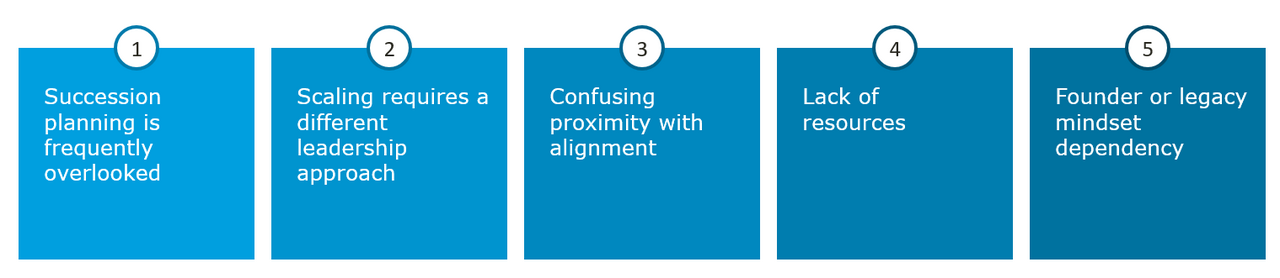
Members of Boyden's Global Industrial Practice identified some common leadership mistakes made by mid-cap industrial organizations.
1. Succession planning is frequently overlooked
Many organizations fail to develop future leaders and build a strong leadership pipeline. This creates risks as the business grows and evolves.
Because mid-cap leaders are often highly capable across multiple domains, the organization can fail to build the depth that sustainable growth requires. Leaders who can do everything sometimes prevent others from developing their full capability.
When a CFO or operations leader departs—or is stretched too thin—there is no talent to fill the gap. For this reason, succession thinking and proactive leadership development are risk-management imperatives.
2. Scaling requires a different leadership approach
Successful transformation depends on delegating effectively, hiring the right expertise, and building structures that can support increased complexity and growth.
In periods of sustained uncertainty, leaders who are involved in every significant decision may become a bottleneck. Mid-cap executives may not be adept at delegating tasks, in part because they are capable of handling so much themselves. When companies develop trustworthy second-tier leadership, delegation becomes more likely and more effective.
3. Confusing proximity with alignment
Leaders who assume that their visibility creates clarity can be surprised to find significant divergence in how strategy is understood across functions. Systematic communication remains essential in smaller organizations.
4. Lack of resources
Mid-caps undergoing transformation may find that their personnel can’t absorb the necessary organizational changes. Lacking the HR infrastructure and change management resources available to large organizations, mid-cap leaders must manage transformation personally and deliberately. There is a real risk that change will cause fatigue, from the leadership on down.
5. Founder or legacy mindset dependency
Many mid-cap industrial companies carry strong cultural imprints from founding leaders or long-tenured executives. This can be a real competitive advantage. But when market conditions shift, adherence to inherited models can inhibit strategic adaptation.
The answer: An overreliance on historical success models can become a trap, Kayser-Dörr points out. It can be helpful to integrate external expertise and introduce new, structured processes and governance models.
The Leadership Profile That Thrives in Mid-Cap Industrial Environments
The leaders who perform most effectively in mid-cap industrial environments tend to share a particular combination of attributes.
- They are operationally fluent. They understand manufacturing, supply chain, and/or engineering dynamics, but also can engage with front-line realities.
- They have a bias for directness in communication, in decision-making, and in managing people.
- They can tolerate ambiguity without becoming paralyzed by it, and they can act on incomplete information without pretending uncertainty does not exist.
Equally important is emotional resilience.
“Build a resilient and adaptable leadership team,” Garforth recommends. “Sustained volatility can be psychologically draining. Success in uncertain times will depend less on predicting the future and more on having leaders who can navigate ambiguity, adapt quickly, and complement one another's strengths.”
Garforth and Kayser-Dörr describe a hybrid leader: Someone who is operationally fluent but also understands trends, anticipates future needs, and can transform the organization for AI, new business models, and what comes next.
What Mid-Cap Industrial Leaders Should Do Now
Several strategic priorities emerge from this analysis for mid-cap industrial leaders navigating the current environment:
Invest in the leadership bench deliberately, not reactively. The cost of a leadership gap in a mid-cap is disproportionate to the organization's size. Proactive succession planning—including honest assessment of who could step up under pressure, and where external talent is needed—is essential.
Build decision architecture, not just decision speed. Agility that relies entirely on individual judgment at the top is fragile. The most resilient mid-cap organizations have clear frameworks for which decisions require which level of authority, and who holds accountability.
Use volatility as a talent window. Periods of uncertainty can make exceptional talent available. For example, leaders in larger organizations who feel constrained by consensus culture or slow decision cycles may look for new opportunities. Mid-caps with the agility and ambition to attract them can make transformational leadership changes while larger competitors are in hiring freezes.
Conclusion: Calibrated for the Moment
There is a reason mid-cap industrial companies represent some of the most dynamic and durable competitors in global markets. Their scale is a deliberate configuration that enables a particular kind of leadership excellence. Close to decisions. Fast to align. Grounded in entrepreneurial confidence. Built to act.
The industrial mid-cap organizations that will lead the next decade are already building the leadership capability to do so: investing in their bench, sharpening their decision frameworks, and holding onto the entrepreneurial nerve that built them. And they are finding, as Boyden's experience across industrial markets consistently confirms, that the best leaders for this moment are those who thrive precisely because the environment is uncertain.
Boyden is a premier global leadership and talent advisory firm, with deep expertise in the industrial sector. With over 75 offices across more than 45 countries, Boyden partners with industrial organizations worldwide to identify and develop the leadership capability that drives long-term performance.