
Aerospace & Defense
AI-Powered Security & Strategy: The Digital Flight Plan
"As AI and advanced technologies reshape aerospace and defense – from fleet management to space exploration – staying ahead is no longer optional. Innovation drives efficiency, sustainability, and global competitiveness. With generative AI transforming talent strategies, the industry is seizing new opportunities to attract, retain, and reskill top talent, ensuring it remains at the forefront of progress and leadership."
Elizabeth Garforth
Partner, France
Global Sector Leader, Aerospace & Defense
- The aerospace & defense industry continues to grow despite challenges in recent years. Commercial aerospace recovered from the impact of the Covid pandemic, with global air passenger traffic up nearly 12 percent YoY in August 2024.
- Global defense spending, driven by intense geopolitical issues, exceeded $2.4 trillion in 2023, according to the Stockholm International Peace Research Institute (SIPRI). The combined military expenditure of NATO members in 2024 is estimated at $1.47 trillion.
- These external factors are sharpening the focus most notably on leveraging technology to enhance fleet management and resiliency in the supply chain; the most prevalent technologies to watch being AI and machine learning (ML), generative AI, extended reality and advanced air mobility technologies (AAM).
- According to Deloitte, 81 percent of respondents in the aerospace & defense industry report use or planned use of AI/ML, with after-market companies also prioritising AI/ML, generative AI and extended reality.
- While a number of industries are bundling technology in a ‘tech stack’, organisations in aerospace and defense are bundling AAM technologies to transform the way people and goods are transported, simultaneously reducing emissions.
- AAM technologies include electric or hybrid vertical take-off and landing aircraft (including drones), AI and digital twin technology. Moving people and cargo more effectively, particularly in underserved environments, is gaining momentum in the United States through the Advanced Air Mobility Coordination and Leadership Act, introduced through the US Department of Transport and NASA, spurring innovation and private capital investment.
- Issues in the supply chain and a mismatch in fleet supply and demand are driving after-market services, supported by AAM, notably maintenance, repair and overhaul (MRO); integrated digital technologies here are delivering efficiency and cost-effectiveness. Looking ahead, intelligent MRO services will be used by commercial companies to secure aircraft availability and by defense organisations to ensure the supply of mission-capable aircraft.
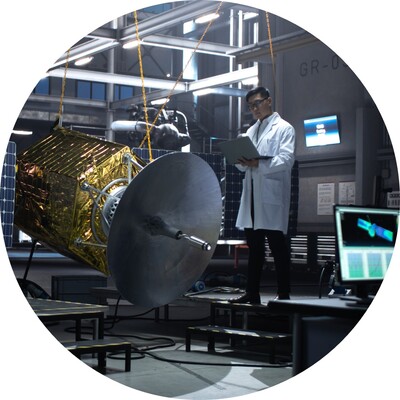
- The classic twin view of aerospace & defense - commercial and military – becomes a kaleidoscope when looking at how AI is transforming space technology. AI/ML is being used in numerous different ways, such as: autonomous spacecraft operations; analysis of satellite data (for example deforestation and changes in sea levels); avoiding the impact of debris on valuable space assets; autonomous robotic exploration; space-based manufacturing processes; predictive maintenance for spacecraft; AI-powered astronaut assistance; space mission simulation; space agriculture; and exoplanet discovery (planets outside the solar system).
- Other important technologies shaping the future of aerospace and particularly defense, are solid rocket motor technologies, used in the development of air-to-air and air-to-ground missiles and in space-related innovation, such as satellite launchers. According to Defense News, the global rocket and missile propulsion market is considered to be worth nearly $60 billion and is expected to reach $93 billion by 2030.
- Tech-led breakthroughs are creating a space race for sovereignty. According to the Space Foundation, the space economy was worth $570 billion in 2023, a 7.4 percent YoY increase, driven mostly by the commercial sector, focusing on location-based services; this area is expected to grow by 155 percent by 2035.
- In 2025, the UK will host the first Farnborough International Space Show, connecting the space ecosystem across industry, defense, government and academia on a global scale.