
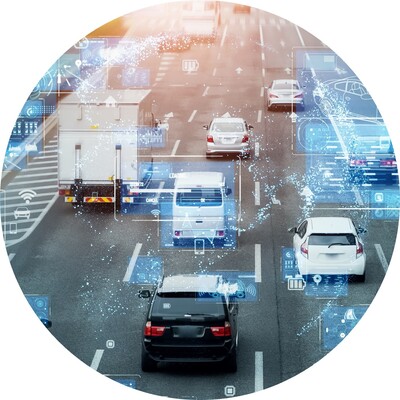
Infrastructure, EPC (engineering, procurement, construction), Transportation
Building the Future: AI’s Impact on Infrastructure & Mobility
- Infrastructure, EPC (engineering, procurement, construction), transportation face a multitude of challenges, including climate change, urban expansion, economic/trade agreement uncertainty, labour shortages/instability and supply chain disruption.
- Projects must be delivered faster and more cost-effectively, through more sustainably-operated assets. AI offers a transformative path to achieving this, enabling change by breaking down barriers between stakeholders, reducing costs and expediting delivery.
- AI is transforming infrastructure through enhancements to mobility, energy and planning, while enabling organisations and consortia to meet social and environmental goals.
- The human factor is increasingly recognised, for example in the development of smart cities, which integrate people, technology and processes across these sectors.
- AI is a key component in smart cities, through data analysis, automation, predictive analytics, service improvement, pollution reduction, waste management, reductions in traffic congestion, improvements in public services and use of real-time information. A key benefit is efficiency, with AI enabling automation of municipal activities and operations on a large scale, reducing duplication and improving effectiveness.
- The infrastructure that forms the backbone of city life is significantly enhanced by AI through predictive maintenance, collaboration, IT infrastructure management (automated tasks such as resource allocation and scaling, optimising cost management and automatic software patches), transportation and construction.
- In 2019, Gartner predicted that a city platform (or ‘cognitive city’ that uses AI and data analytics to maximise data value, improve planning and enhance decision-making) will be a mature smart city solution by 2029. At that stage, Gartner anticipates between 1 to 5 percent of cities will be using a city platform to manage their operations.
- Managing infrastructure, EPC and transportation can also be enhanced through digital twins. City leaders in Dublin, Ireland and Singapore have created digital twins for urban planning, disaster simulation and assessment of wind and shade in streets and parks for population well-being. Machine learning will also be used to predict future events and trends.
- In EPC, AI technologies are boosting efficiency, enhancing safety, streamlining operations, fostering innovation and sustainability, and reducing human error. All this prompts a redefinition of responsibilities and liabilities, with a need for a modern-day approach to contracts, procurement models, insurance and internal policies.
- Contract drafting will need to incorporate the implications of AI in liability (with AI taking on autonomous roles), data protection, intellectual property, as well as the impact of AI on procurement, insurance and internal policies. Interdisciplinary cooperation is important for paving the way for new legal frameworks; these will need to take into account the potential of AI while finding a balance between innovation and risk mitigation in a technologically advanced and legally compliant construction industry.
- Forbes highlights challenges for the transport industry, moving people and goods through multi-modal systems against fragmented networks, congestion, emissions, safety issues, subsidies and inefficiencies caused by outdated government policy. The expense of running transport systems is increasing, while public affordability is in decline as households balance expenditure on key priorities. Generative AI offers the potential to bridge this gap by reorganising and optimising the way transport companies move people and goods.
- While traditional technologies provided data in discreet, closed systems, generative AI is accessible to users in different areas, such as vehicle design, urban planning, community championing, policy making and business integration, all in real time. The result will be levels of information, access and collaboration never before seen.
- Furthermore, the distilling of massive datasets into images and video will enable people with various levels of understanding across different areas to see how the world around them might look; they will be able to see different scenarios for a street, transport vehicle, service or site, with simulations of future situations based on data, weather forecasts, cultural preferences and real-time trends. The ability to leverage existing scenarios to create new ones makes generative AI particularly attractive to governments, businesses and investors across these sectors.
“As AI accelerates transformation across infrastructure, EPC, and transportation, companies must determine their position, whether leading the charge, adapting as fast followers, or risking stagnation. Regulatory frameworks and oversight will play a critical role, shaping how organizations balance innovation with risk in an industry where safety, efficiency, and long-term resilience are paramount.”
Patrick Reynolds
Managing Partner, Canada
Global Sector Leader, Infrastructure, EPC, & Transportation