The consumer-packaged goods (CPG) industry has historically been a top contributor to Canadian jobs and to the Canadian economy. In recent decades, consolidation and the perception of Canada as an extension of the U.S. by multinationals have reduced the country’s head office count. More recently, increasing costs and heavy regulation have further challenged domestic growth and innovation in the sector. The COVID-19 pandemic has amplified these trends. While the bigger picture may be discouraging, a look at the executive ranks of CPG organizations suggests that, with a focus on innovative and diverse leadership, there may still be untapped market potential and plenty of room to grow.
The most current statistics illustrate that the CPG industry has grown to become the largest manufacturing employer in Canada, with 300,000 jobs across the country, accounting for more manufacturing jobs than the automotive and aerospace industries combined. By 2017, the CPG sector contributed nearly $30 billion to Canada’s GDP, and by 2018, the value of exports had grown to $36 billion, extending to more than 190 countries worldwide. Importantly, the sector also purchased 40% of Canada’s agricultural production.
Despite this profound contribution to the economy, the CPG industry in Canada has been struggling over the last few years, and many worry about its sustainability. A recent study commissioned by Food, Health & Consumer Products of Canada, an organization representing a significant portion of CPG manufacturers, looked at the industry’s underperformance across a number of areas. Modest growth in revenue and profits, increasing costs and trade spend, shifts in the employment landscape, and limited Canadian innovation have resulted in the industry growing at a slower pace than the Canadian economy as a whole.
The same cannot be said for the industry’s trajectory in other geographic markets, particularly the developing world. Product innovation is driving growth on a global scale – just not here.
ROOM TO GROW
The good news in the study is that there is potential. We have foundational strengths here in Canada. Thanks to ample arable land and water and growing global demand, the food sector alone has the potential to contribute more significantly to Canada’s GDP if it can overcome challenges presented by exchange rates and rising costs.
A closer look at the organizations that make up the sector shows there may be other reasons for hope.
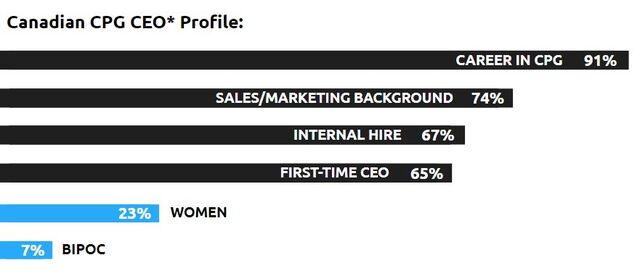
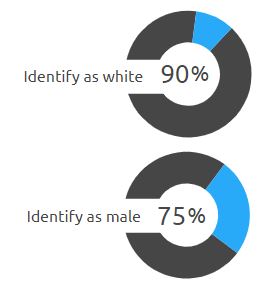
In late 2020, Boyden Executive Search studied the profiles of the most senior executives leading more than 100 food, health and consumer goods organizations. The companies represent a wide range of sizes and revenues, from the likes of Hawkins Cheezies to McCain Foods and Coca-Cola. Sixty percent of the CEOs* in the study are leading the Canadian subsidiary of a global multinational that manufactures and distributes in Canada and 40% are leading made-in-Canada firms.