About the Port of Vancouver
The Vancouver Fraser Port Authority is the federal agency responsible for the stewardship of the lands and waters that make up the Port of Vancouver, Canada’s largest port. Trade through the Port of Vancouver connects Canadian businesses and consumers with the variety of products that they use every day from markets across the globe and generates tax revenues and secure employment for local communities.
Supporting national trade objectives on behalf of all Canadians
As a Canada Port Authority, the Port's mission is to enable Canada’s trade through the Port of Vancouver, while protecting the environment and considering local communities.
Accountable to the federal minister of transport, Canada Port Authorities manage federal lands and waters in support of national trade objectives for the benefit of all Canadians. The port authority does this by leasing the federal lands that make up the Port of Vancouver to independent terminal operators who handle trade through the port, and by providing marine, road and other infrastructure to support port growth and function.
As outlined in the Canada Marine Act, the port authority is required to facilitate Canada’s trade objectives, ensuring goods are moved safely, while protecting the environment and considering local communities. Canada’s trade through the port has been increasing steadily for a decade and is forecasted to keep growing at about 3.6% annually, so the port authority is planning for sustainable port growth to ensure Canada remains competitive on the global stage.
Port of Vancouver: Canada’s largest port
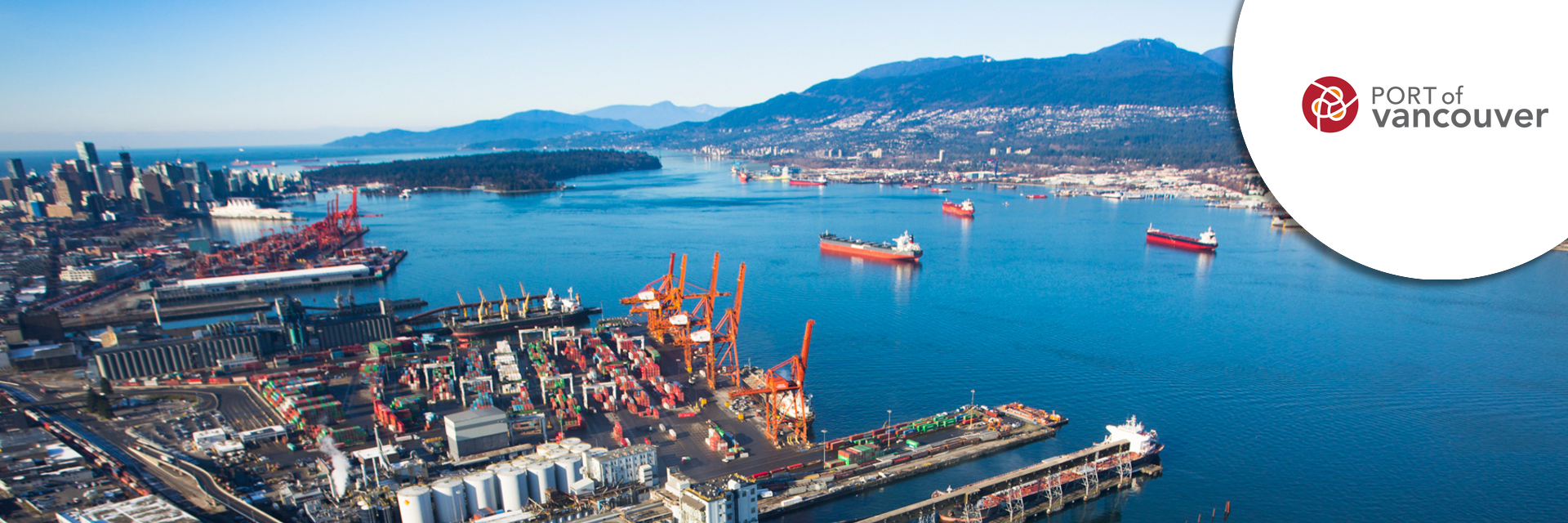
Located on the southwest coast of British Columbia, the Port of Vancouver extends from Roberts Bank and the Fraser River up to and including Burrard Inlet. Geographically, the Port of Vancouver includes more than 16,000 hectares of water, more than 1,500 hectares of land and 350 kilometers of shoreline, bordering 16 municipalities and intersecting the traditional territories and treaty lands of several Coast Salish First Nations.
The Port of Vancouver is about the same size as the next five largest Canadian ports combined. Home to 27 major terminals, the Port is able to handle the most diversified range of cargo in North America: bulk, containers, breakbulk, liquid bulk, automobiles and cruise. As the country’s gateway to over 170 trading economies around the world, the port handles $1 of every $3 of Canada’s trade in goods outside of North America. Enabling the trade of approximately $240 billion in goods, port activities sustain 115,300 jobs, $7 billion in wages, and $11.9 billion in GDP across Canada.




 Download / View: Organization Chart